A shark filmed leaping behind a beachgoer at Marina State Beach is drawing renewed attention after officials compared footage from another camera. The sighting dates to October 17; corroboration supports the reported breach, while the animal’s motive and exact circumstances remain uncertain.
A beach portrait became an unexpected wildlife story when a large shark rose out of the surf behind a woman at Marina State Beach in California. The video is attracting another wave of attention in October 22 coverage, including a segment from Orlando’s News 6. The distinction in dates matters: the new discussion concerns a sighting reported from Saturday, October 17, rather than a shark newly recorded today. October 22 coverage.
The clip’s striking composition has prompted doubts as well as fascination. A surprising animal appearing in precisely the right place can resemble a staged or synthetic image. The useful response is to examine the evidence behind this particular recording, while resisting the temptation to turn either surprise or scepticism into a complete verdict.
Who filmed the moment, and when
NewsNation’s account identifies Rania Melhem, who was at the beach with her sisters, and Erin King, the beachgoer they had befriended. As Melhem prepared to photograph King, the shark appeared behind her. Melhem told Storyful that the group replayed the recording while trying to understand what it showed. This is a participant’s account, supported by the circulated recording; it is not a controlled wildlife observation. NewsNation report and participant account.
FOX Weather’s October 20 report credits the material to Rania Melhem and Erin King via Storyful and dates the scene to October 17. ABC News also published the scene in its October 20 video coverage. Together, those dated records help distinguish the underlying incident from later reposts and reaction segments. FOX Weather; ABC News video report.
That chronology is relevant to authenticity. A later upload can preserve an original event, but its publication timestamp does not establish the event’s date. Captions that describe this as happening today would change the claim without changing a single frame of the video.
The strongest corroboration concerns the camera views
KSBW reported that state-park officials compared matching timestamps from separate camera views. KSBW verification report.
NewsNation likewise reported that California State Parks compared the recording with another video from Marina State Beach at the same time. The significance is the independence of the viewpoint: a second recording of a breach in the relevant area and time is stronger evidence than many accounts repeatedly uploading one copy. Reported camera comparison.
There remains a difference between corroborating a breach and reconstructing every detail of the animal’s movement. Matching time and place substantially supports the reported event. It does not produce a precise underwater track, an exact distance from the person or a reliable explanation of why the shark surfaced. Those require evidence beyond a brief view above the waves.
Why appearance alone is a weak authenticity test
A clip can look unusual because the event is unusual, because the camera angle compresses the scene, because it has been edited, or because it was generated. Those are competing possibilities to investigate, rather than conclusions available simply from a viewer’s reaction. The fact that one possibility exists does not establish that it applies here.
For this recording, the dated reporting and reported second-camera comparison give the discussion a firmer basis than a vote on whether it “looks real.” Conversely, recognition of a genuine event should not make every caption attached to it reliable. The date, location, species, dimensions and behaviour remain separate claims that need their own support.
There is no need to invent a million-view figure to explain the story’s appeal. The visible juxtaposition is unusual enough: a person posing at the shore while a large animal appears in the background. Describing the verified sequence accurately preserves that interest without escalating it into an unsupported account of an attempted attack.
A breach does not reveal an intention towards a person
The News 6 segment describes the animal as appearing to be a great white and notes that some sharks breach while ambushing prey. It also says the reason for this particular jump is unclear. A general description of a behaviour should not be converted into a claim that the shark was hunting the woman on shore. What the reaction segment establishes.
The word “photobomb” describes the human experience of the composition, not an intention attributed to the shark. The same caution applies to dramatic terms such as monster or missile. They convey surprise, but they do not measure the animal’s size, speed or purpose. A clear account can describe a large shark breaching without treating a metaphor as biological evidence.
Why white sharks occur along this coast
California’s Department of Fish and Wildlife describes white sharks as predators found in both coastal and offshore waters. It distinguishes younger animals’ diets, including fish and rays, from the broader diet of larger sharks, which can include marine mammals. That background helps explain why an identified white shark near a coast is biologically plausible. It does not identify what the animal in this video was pursuing. CDFW white-shark information.
NOAA Fisheries describes the species as wide-ranging, using temperate and subtropical seas, with habitat preferences changing as sharks grow. Young animals can occupy shallow coastal habitat, while older animals also travel offshore. The species’ use of the nearshore environment is therefore not, by itself, evidence that an animal is stranded or behaving abnormally. NOAA species account.
The Monterey Bay White Sharks research project places Central Coast sightings within a broader ecological setting. Its coastal-presence material describes the California Current’s food web and electronic-tagging research into movement and habitat use. A brief encounter becomes more understandable when considered alongside that sustained observation of the ecosystem. Monterey Bay research context.
One striking observation is not a population trend
A widely shared video can make an animal feel newly abundant even when the available evidence concerns one incident. Several separate reports can also describe the same animal or the same period of activity. Counting posts would therefore be a poor substitute for counting animals with a defined method.
NOAA notes that important questions about white-shark abundance, habitats and movements remain unanswered despite extensive study. The species grows slowly and is vulnerable to human pressures. Those facts make it especially important to distinguish a conspicuous sighting from a reliable estimate of population size or a claim about how quickly numbers are changing. NOAA on knowledge and conservation.
The research project’s ocean-monitoring material describes approaches including tagging-related observation, drones, genomics and environmental DNA. These techniques answer different questions and operate at different scales. A tourist’s video can contribute a useful observation without replacing the longer records needed to interpret a regional pattern. Ocean-monitoring methods.
The advisory needs its own date
The October 20 reporting said State Parks had issued a shark advisory after the sighting. That is a dated report of official action; it should not be silently converted into a claim that a particular warning or closure remains unchanged at the time any reader visits. Current instructions from park staff and posted notices are the relevant information for a present-day trip.
It is also important to distinguish an advisory from a report of injury. The story concerns a shark appearing in the surf behind a beachgoer. The dramatic recording does not, on its own, establish a bite, a pursuit of that person or a rescue operation. Adding those elements would change the story rather than explain it.
CDFW’s guidance discourages swimming where sharks have been observed or seen feeding and explains that white sharks are protected. Wildlife curiosity should not become an attempt to attract or approach the animal for a more dramatic recording. Local safety directions and the animal’s protection are compatible with appreciating an unusual encounter. CDFW guidance.
What the accompanying photograph represents
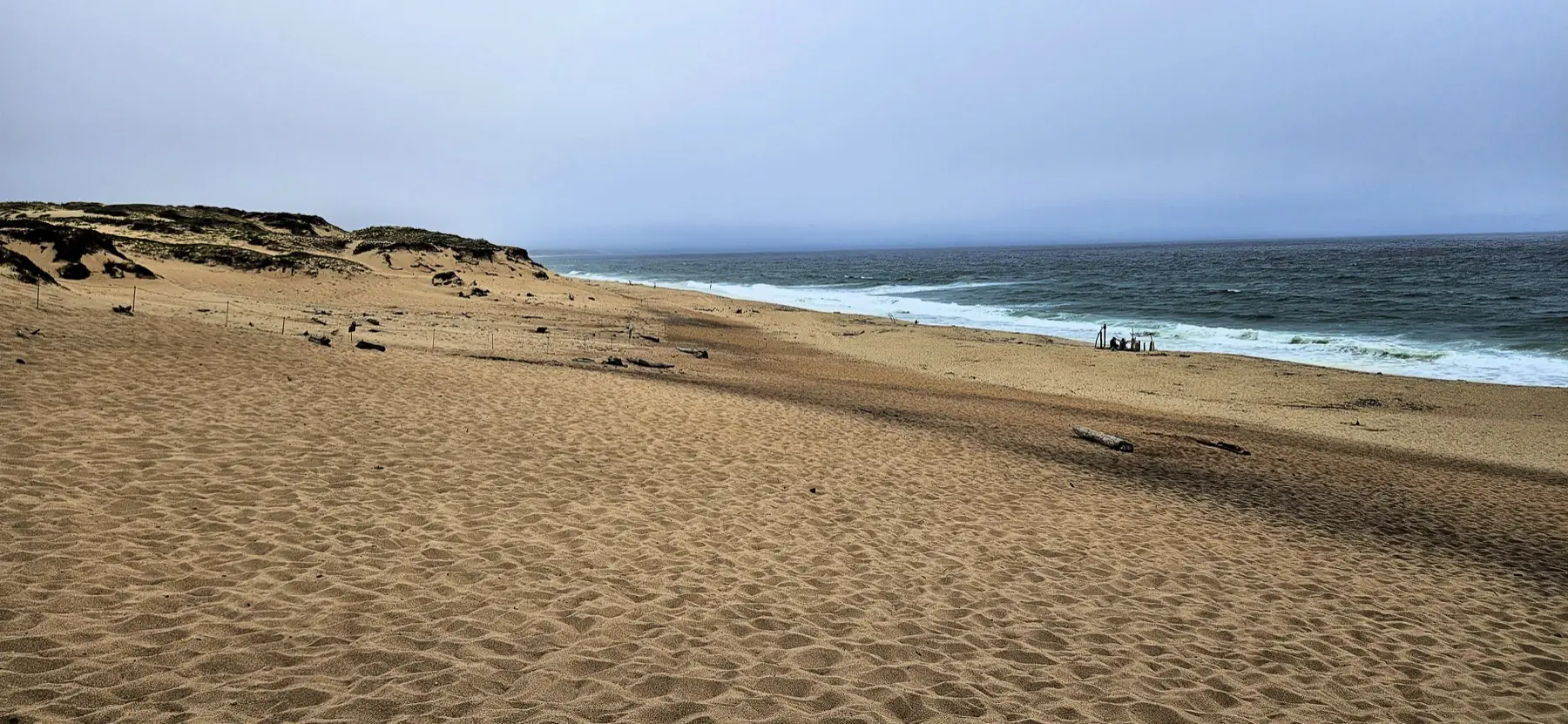
The image accompanying this article is a licensed archive photograph of Marina State Beach from July 2023. It illustrates the location and is explicitly dated in its caption. It is not a frame from the shark recording and provides no independent evidence about the October 17 breach.
That distinction matters when a story is about visual verification. A genuine photograph can still mislead if its caption implies that it depicts a different event. Keeping the archive date, the photographer’s credit and the image’s purpose together prevents an illustration from becoming an accidental addition to the claim. The video evidence and the location illustration perform different roles in this report.
How to share the clip without changing the evidence
An accurate caption can name Marina State Beach, retain the October 17 event date and explain that officials reportedly compared another camera view. It can describe the breach without adding an exact distance or speculative motive. Keeping those details attached makes a repost more informative than a cropped copy carrying only a dramatic reaction.
Our recent explanation of moth-related radar echoes addressed another case where an unexpected image needs interpretation. The evidence can support a real phenomenon while leaving narrower questions unresolved. That combination is a normal feature of careful reporting, not a reason to abandon the evidence.
The Marina recording remains remarkable on the supported account: a beach portrait captured a shark breaching, and an additional camera view was reported to corroborate the event. Today’s renewed attention adds another chapter to its circulation. It does not require a new event date, a fabricated attack narrative or certainty about an animal’s intention.
Smashology Editorial Team
The Smashology Editorial Team is responsible for reviewing and publishing content at Smashology Media, overseeing sourcing, fact-checking, corrections, and editorial standards across coverage of internet culture, technology, entertainment, news, and crime.
Sources
Links cited in this article.
- Original sourcecommons.wikimedia.org
- reuse termscreativecommons.org
- October 22 coverageclickorlando.com
- NewsNation report and participant accountaol.com
- FOX Weatherfoxweather.com
- ABC News video reportabcnews.com
- KSBW verification reportksbw.com
- CDFW white-shark informationwildlife.ca.gov
- NOAA species accountfisheries.noaa.gov
- Monterey Bay research contextmontereybaywhitesharks.org
- Ocean-monitoring methodsmontereybaywhitesharks.org