Atlanta defeated Golden State 97–71 in Game 3 to take a 2–1 lead in the best-of-seven WNBA Finals. Angel Reese supplied 21 points and 12 rebounds, while the Dream’s third-quarter response and defensive pressure turned a tied contest into a decisive home victory.
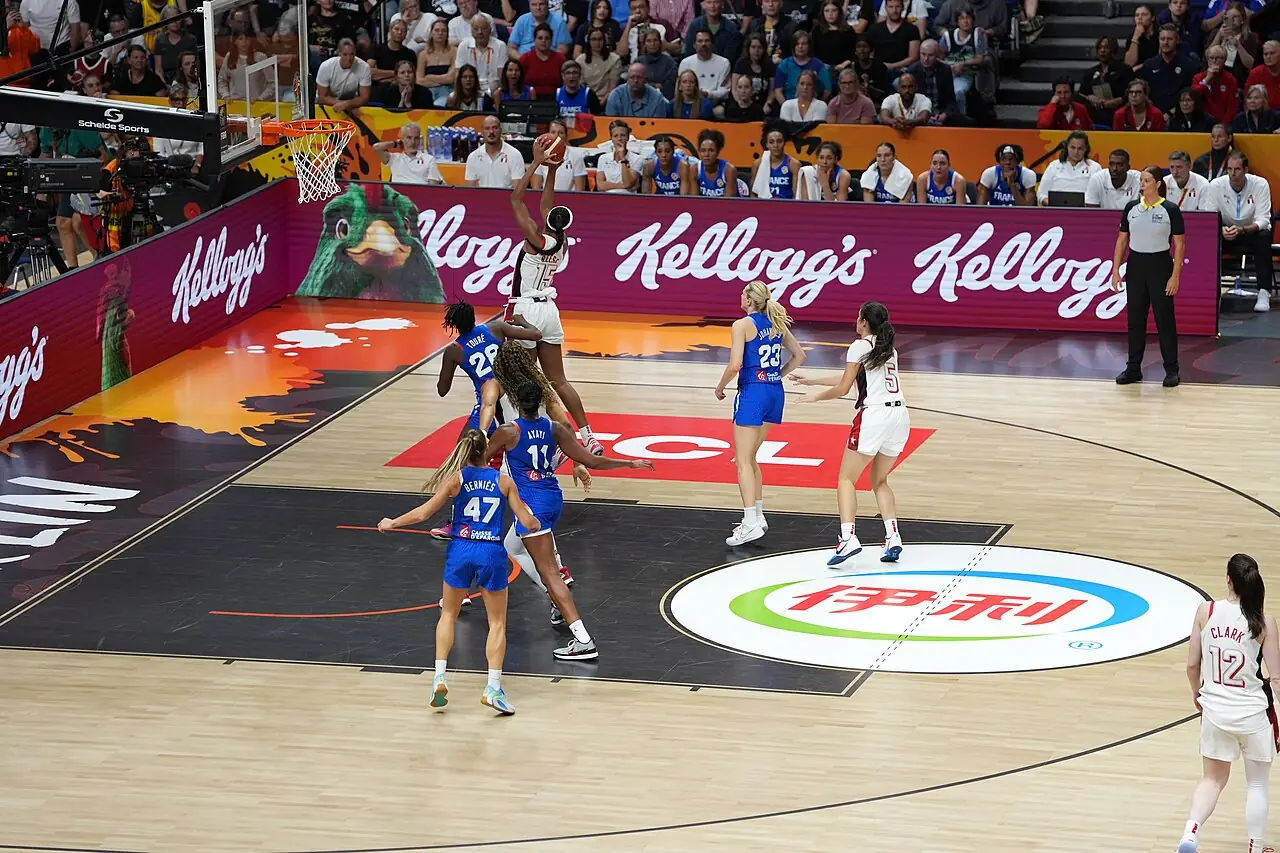
The Atlanta Dream have taken control of the WNBA Finals scoreline, moving ahead 2–1 after a 97–71 victory over the Golden State Valkyries at State Farm Arena. The game was played Wednesday, October 21, in Atlanta, with the result reaching European readers early on October 22. It was a second consecutive win for the Dream, rather than a championship-clinching result. Official game page.
The final margin conceals an important turn in the contest. Golden State recovered from an early deficit and drew level in the third quarter before Atlanta re-established control. That response gives the Dream a stronger story than simply leading from the opening period: they had to solve a moment of pressure before the game became comfortable.
The decisive response came after the tie
The Associated Press recap carried on the WNBA’s game page records a 49–49 tie in the third quarter, followed by eight straight Atlanta points. Golden State later closed to 59–55, but Atlanta finished the period with 12 of the final 14 points. The Dream led 71–57 entering the fourth. That sequence explains how a competitive game became a much larger victory. AP recap on the league site.
The period totals underline the shift. Atlanta won the first quarter 23–15, the second was 25–23 to Golden State, and the Dream took the third 25–17 and fourth 26–14. Calculated from those official figures, Atlanta outscored the Valkyries 51–31 after halftime. The six-point interval advantage therefore became a 26-point final margin. Official linescore.
That arithmetic is useful because it keeps the analysis tied to what happened. A big fourth-quarter margin can include minutes after the main contest has been decided. Here, the third-quarter response had already produced a 14-point cushion. The late scoring extended control that had been established earlier, rather than creating the whole advantage from nothing.
Reese combined volume with efficient finishing
The official box score lists Angel Reese with 21 points, 12 rebounds, three assists and three steals. She made seven of 12 field-goal attempts, both of her three-point attempts and all five free throws. Those figures describe several ways of influencing the game, rather than scoring generated simply by taking a very large number of shots. Official player statistics.
Her two made threes are also worth interpreting at the correct scale. They contributed six points in this game and required Golden State to account for her away from the basket. Two attempts do not establish a new long-term shooting percentage or predict how frequently she will take that shot in the remaining Finals. The contribution is real without needing that larger claim.
Rebounding offers another route to influence. A defensive rebound can complete a successful stop and create an opportunity to advance the ball. An offensive rebound can extend a possession that would otherwise end. The total matters, but the distinction between those actions helps explain why a double-double is more than two unrelated numbers in a headline.
Atlanta’s own recap highlights record-setting contributions
The Dream’s recap says Reese became the youngest player to record double-doubles in three consecutive Finals games and the youngest to produce at least 20 points and 10 rebounds in consecutive Finals games. The team also credited Rhyne Howard as the first player with at least five steals in successive Finals games. These are league-history claims attributed to the team’s published account, alongside the independently visible box-score production. Dream recap.
The same account describes Karl Smesko considering a timeout when the third quarter began poorly, then observing his players work through the problem themselves. That is the coach’s interpretation of the response. It supports a reading of a team adjusting under pressure, while leaving the actual sequence of scores available to judge separately.
The value of that adjustment goes beyond emotional language about momentum. Players who can recognise a problem and communicate during live play may preserve a possession or defensive assignment before a stoppage arrives. This game supplies an example of a successful response; it does not prove that Atlanta will solve every future challenge without intervention.
Howard’s defense sat alongside a balanced offense
Howard finished with 16 points, four assists, five steals and a block. Naz Hillmon scored 15, Isobel Borlase 12 and Jordin Canada 10, giving Atlanta five double-figure scorers. Canada also supplied eight assists. Allisha Gray added six assists despite scoring eight points, another reminder that a player’s offensive contribution need not be captured by the points column alone. WNBA box score.
The spread of production matters for defensive preparation. If one player is the only reliable source of offense, an opponent can concentrate more resources there. When several players finish opportunities or make the next pass, stopping the first action becomes only part of the task. Atlanta’s scoring distribution illustrates that variety on this evening without establishing that every combination worked equally well.
Steals also have value beyond taking away an opponent’s shot attempt. They can create chances against a defense that has not yet organised. The benefit still depends on what follows: an interception that ends in a poor decision is different from one converted into a controlled scoring opportunity. Howard’s defensive output belongs alongside the team’s use of the resulting possessions.
The shooting gap was larger inside the arc
Atlanta made 34 of 69 field-goal attempts, compared with Golden State’s 24 of 69. The Valkyries actually made more three-pointers, 12 to nine, while both teams shot around 40% from long range. A simple claim that Golden State lost because it could not make threes would therefore miss the evidence. Team shooting totals.
Subtracting made threes from all made field goals gives 25 two-point baskets for Atlanta and 12 for Golden State. That is a calculated comparison, not a separate official advanced metric. It identifies where much of the scoring separation occurred, although the shot totals alone do not establish how every attempt was defended or created.
The league’s game summary also lists points in the paint at 44–20 for Atlanta and points off turnovers at 22–7. These categories help connect the result to the quality of chances and the consequences of lost possessions. They should not be added together as independent components of the final margin because the same basket can belong to more than one category. Official game summary statistics.
Golden State had contributions, but not enough conversion
Gabby Williams led the Valkyries with 15 points and eight assists but shot five of 18. Tiffany Hayes scored 14, and Cecilia Zandalasini and Janelle Salaun each supplied 13. AS’s report likewise identified those contributions and the stronger Atlanta second half. The defeat was not a complete absence of offensive production; it was an inability to match the Dream’s overall output and sustained response. AS report.
Golden State’s successful three-point stretches gave it a way back into the game. The more demanding question for the next meeting is how to make that route part of a broader attack, while limiting the extra opportunities Atlanta obtained through pressure and interior scoring. That is an analytical question raised by this result, not a claim about a tactical change already announced by the Valkyries.
The venue and schedule are part of the setting
The official game information records attendance of 17,099 at State Farm Arena. The AP recap explains that the Atlanta games had been moved from the smaller Gateway Center Arena to accommodate a larger crowd. The result belongs to that specific home setting; it should not be described as occurring at the Dream’s usual smaller venue. Venue and attendance.
Game 4 is scheduled for Saturday, October 24, in Atlanta. The official Valkyries watch-party listing at Chase Center also identifies that date, showing a 10 a.m. local start for the Bay Area event. Those are future arrangements as of this article, not another game already played. Official Game 4 watch-party information.
The best-of-seven format means four wins are required. Atlanta’s two victories leave two more needed, and Golden State still has a route back. The next game could either extend Atlanta’s advantage or restore a level series. A 26-point margin is substantial evidence about Game 3, but it does not carry points into the opening possession of Game 4.
The series arithmetic gives the next game particular importance without requiring a prediction. An Atlanta win would create a 3–1 lead, leaving the Dream one victory short of four. A Golden State win would make the series 2–2, with neither team having a numerical lead. Those are possible outcomes of the scheduled game, not probabilities assigned by this report.
That distinction keeps attention on the contest that remains to be played. The margin from Game 3 can inform preparation, but a future result depends on new possessions and decisions. For both teams, the useful task is to identify repeatable strengths and correctable problems rather than assume the previous score must reproduce itself.
What this adds to the series so far
Our Game 2 coverage examined Atlanta’s response after losing the opener. Game 3 supplies a different development: the Dream followed that away victory with a successful defense of home court and a lead in the series. The challenge now is sustaining the features that made the response effective.
For Atlanta, those features include efficient scoring from Reese, disruption from Howard and enough support to keep the offense varied. For Golden State, the positive stretches that produced the third-quarter tie offer evidence to work with, alongside clear problems in conversion and possession outcomes. The Finals remain unfinished, but Atlanta have earned the stronger position heading into Saturday.
Smashology Editorial Team
The Smashology Editorial Team is responsible for reviewing and publishing content at Smashology Media, overseeing sourcing, fact-checking, corrections, and editorial standards across coverage of internet culture, technology, entertainment, news, and crime.
Sources
Links cited in this article.
- Original sourcecommons.wikimedia.org
- reuse termscreativecommons.org
- Official game pagewnba.com
- Official player statisticswnba.com
- Dream recapdream.wnba.com
- AS reportas.com
- Official Game 4 watch-party informationchasecenter.com