Wedgewood Polls, a little-known polling firm whose surveys were picked up by major news organisations and election trackers during the 2026 midterm cycle, has admitted that almost all of its polls were made up. The admission came on the night of Tuesday, October 20, after the polling analysis outlet FiftyPlusOne confronted the firm with evidence that its raw data was fake. Less than two weeks before the midterm elections, it has set off an argument about how easily fabricated numbers can get into the news.
The firm called the whole operation an “experimental project” meant to expose weaknesses in the polling industry. Candidates, strategists and the industry’s own professional body don’t accept that. Some say the fake numbers had real consequences, including one Senate candidate who says a Wedgewood poll helped end her campaign.
What Wedgewood Polls Admitted
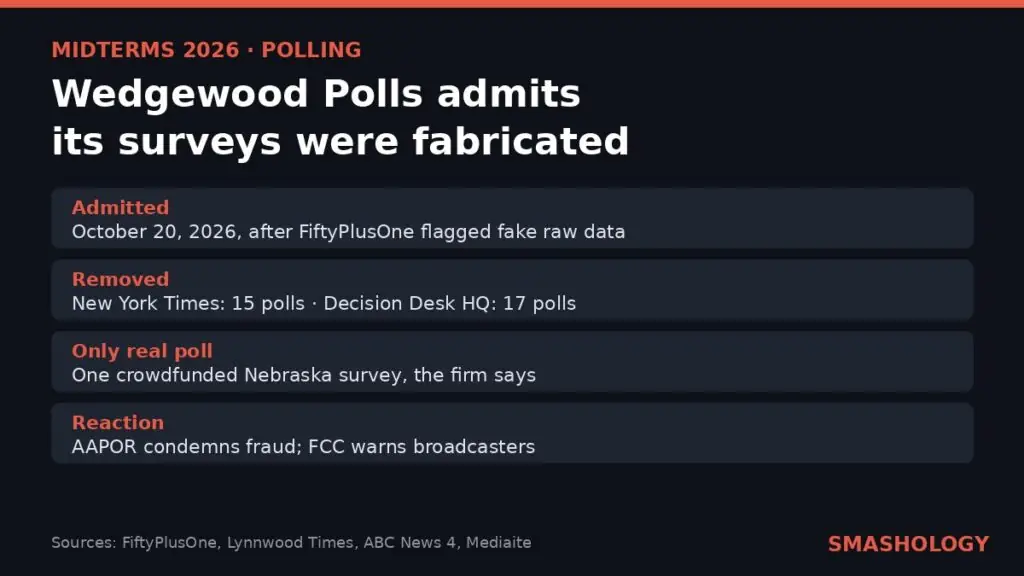
In a statement posted on X, which opened with “The polling industry needs major reform,” Wedgewood Polls said most of its published surveys were fabricated. According to reports on the statement, the firm said it had been “far too easy” to get its numbers into major outlets and onto the main poll aggregators.
The firm said its goal was to show how quickly a made-up polling company could gain credibility. It said it had been listed by The New York Times, FiftyPlusOne and VoteHub, and it called the project a wake-up call rather than an attempt to interfere in elections.
Wedgewood said only one of its polls was real: a crowdfunded survey in Nebraska, which it described as an internal baseline. A GoFundMe for its Nebraska governor and Senate polling reportedly raised $500 of a $5,000 goal.
How FiftyPlusOne Exposed the Fake Polls
The fake polls came to light through ordinary verification work. FiftyPlusOne asked Wedgewood for respondent-level data from its October 12–14 Mississippi Senate survey, which the firm said had been run through the online survey platform Pollfish.
FiftyPlusOne’s analysis found problems that didn’t match genuine Pollfish records, including irregular respondent identifiers and suspicious timestamp patterns. On October 15, Wedgewood sent over raw data that investigators later concluded was fraudulent. When FiftyPlusOne went back to the firm on October 20 with specific evidence, Wedgewood posted its “experimental project” statement instead of answering in detail.
When asked about its methodology, Wedgewood had named Jack Sims and Andrew Prater as the people behind it. FiftyPlusOne confirmed that Sims had previously worked in the polling industry, which may help explain why aggregators treated the firm as legitimate. Wedgewood’s website has since gone offline.
FiftyPlusOne co-founder G. Elliott Morris rejected Wedgewood’s claim that aggregators had simply failed to vet it. He pointed out that the firm sent fraudulent raw data when asked for proof.
Which News Outlets Cited Wedgewood Polls?
The fake numbers reached a wide audience. Outlets and trackers that cited or listed Wedgewood Polls data include The New York Times, MS NOW, Newsweek, Decision Desk HQ, VoteHub, FiftyPlusOne and Mediaite.
Earlier in October, MS NOW featured a Wedgewood poll showing Democrat Jocelyn Benson ten points ahead of Republican John James in the Michigan governor’s race. A July Wedgewood survey showed Democrat James Talarico leading Republican Ken Paxton 64% to 30% among Hispanic voters in the Texas Senate race.
The clean-up was fast once the admission came. The New York Times removed 15 Wedgewood polls released between June and October and added an editor’s note saying: “Wedgewood released a statement admitting it had fabricated data for its polls.” Decision Desk HQ removed 17 polls but said its projections for control of the Senate and House did not change. VoteHub and Nate Silver’s Silver Bulletin also dropped the firm’s data.
The Candidates Who Say the Polls Hurt Them
The sharpest criticism has come from candidates whose races Wedgewood Polls covered.
In Michigan’s Democratic Senate primary, a late-June Wedgewood survey showed state Sen. Mallory McMorrow at 9%. McMorrow says the release hurt donations and volunteer morale and added to pressure on her to quit. She left the race on July 5. Responding to the admission, she said donors pulled funding and volunteers were “devastated,” and added: “Polling is broken.” Reports also say Abdul El-Sayed’s campaign cited the Wedgewood numbers against McMorrow and Haley Stevens during the primary.
Jennifer Holdsworth, a Democratic strategist who ran a super PAC supporting McMorrow, said donors used the poll as a reason to pull back while her side was being outspent by $80 million.
In Mississippi, a Wedgewood poll released around the time Sabato’s Crystal Ball moved the Senate race from Safe to Likely Republican showed Sen. Cindy Hyde-Smith only narrowly ahead of Democrat Scott Colom. A few days later, Senate Majority PAC announced a $1.2 million ad buy supporting Colom. Donald Trump won Mississippi by almost 23 points in the last presidential election, which helps explain why the tight result raised eyebrows.
Industry and Regulator Reaction
The American Association for Public Opinion Research (AAPOR) condemned the fabrication. It said there is “no basis for intentionally fraudulent behavior that misleads the public.” AAPOR president Mary Losch described it as part of a pattern of bad actors.
Critics, including FiftyPlusOne and AAPOR, say the “experiment” explanation doesn’t hold up. They note that Wedgewood only confessed after it was asked to respond to specific evidence, and they say raising donations while publishing fabricated results raises its own ethical questions.
Federal Communications Commission Chair Brendan Carr also weighed in. He warned that broadcasters who aired the polls could be violating federal license rules against news distortion and broadcast hoaxes.
Democratic strategist Mike Nellis, a former adviser to Kamala Harris, called the operators “absolute scumbags” and said they should face prosecution.
Wedgewood Polls Is Not the First Fake Pollster This Year
Wedgewood Polls is the second polling operation in two months to admit it published invented numbers. In August, Median Strategies shut down after admitting that its polls of the Wisconsin Democratic gubernatorial primary and the Los Angeles mayoral primary were not based on real interviews. It also called its work a “short-term social experiment.” Median shut down after the Los Angeles Times confronted it about its data.
Two cases with the same excuse in one cycle have raised concern about how much the polling ecosystem depends on trust. Aggregators usually rate pollsters on their track records, transparency and methodology statements. A new firm with a plausible website, a named team and steady releases can get listed before anyone checks its raw data in depth.
Why the Wedgewood Polls Scandal Matters Before the Midterms
Polls do more than describe a race. Donors use them to decide where to spend, parties use them to decide which races to target, and journalists use them to frame coverage. A single poll can push money toward one candidate or away from another, as the McMorrow and Mississippi cases suggest.
The timing makes it worse. With the midterms less than two weeks away, voters and journalists are relying heavily on polling averages to judge competitive Senate, House and governor’s races. Outlets that cited Wedgewood Polls are now auditing what they published, and readers have good reason to check who is behind any poll that seems to show a big shift.
For news consumers, a few checks help. Look for pollsters with a track record over several election cycles. Check whether a firm publishes its methodology, sample size and fieldwork dates. Be wary when a single unfamiliar poll differs sharply from the average. Established aggregators are adding more checks after this case, but none of these steps fully protects against a determined fabricator.
How Wedgewood Polls Looked Legitimate
Part of what made Wedgewood Polls convincing was how ordinary it looked. It had a website, named staff, regular releases and methodology claims that mentioned a real survey platform. Its numbers were often close enough to other polls that they didn’t stand out, but occasionally different enough to make headlines. That mix of plausibility and newsworthiness is exactly what aggregators and journalists now say they need to watch for.
What Happens Next
It is not yet clear whether Wedgewood Polls or the people behind it will face legal action. No charges have been announced. FiftyPlusOne says it is continuing its investigation, and the FCC warning puts pressure on broadcasters who aired the numbers.
For the aggregators, the fallout is already shaping how they vet new pollsters. Several have said they are reviewing how they handle firms with no track record. That review will matter more as cheap online survey panels make it easier for anyone to call themselves a pollster.
Frequently Asked Questions
What is Wedgewood Polls?
Wedgewood Polls was a polling firm that released surveys on 2026 midterm races. On October 20, 2026, it admitted that nearly all of its polls were fabricated.
Which outlets used Wedgewood data?
The New York Times, MS NOW, Newsweek, Decision Desk HQ, VoteHub, FiftyPlusOne and Mediaite cited or listed its polls. The Times removed 15 and Decision Desk HQ removed 17.
Was any Wedgewood poll real?
The firm says one crowdfunded Nebraska survey was genuine. It says the rest were made up.
Will anyone be prosecuted?
No charges have been announced. Some strategists have called for prosecution, and the FCC has warned broadcasters about airing the fake polls.
Sources
Lynnwood Times: FiftyPlusOne exposes fabricated poll data, Wedgewood says it was an ‘experimental project’
ABC News 4: Fake polling firm tricked media, claims fabricated surveys were for ‘social experiment’
Mediaite: National polling company admits it’s totally fake
The Washington Times: Bogus polling firm admits to fake numbers
Democracy Now!: Headlines for October 23, 2026
Leon Ramoviq
Primary Author · Editorial Reviewer · Researcher Leon Ramoviq is a digital media researcher, content creator, and primary author at Smashology Media. His work focuses on researching, verifying, and developing stories across entertainment, culture, sports, internet trends, curiosity-driven topics, and viral news. Before publishing, Leon reviews sources, cross-checks key claims, and works to ensure that articles are clear, accurately represented, and based on reliable information rather than unverified social-media speculation. With experience in digital media, graphic design, social media content, and online audience engagement, he brings both an editorial and visual perspective to the stories published on Smashology. Leon is particularly interested in how stories spread online, why certain topics capture public attention, and how complex or trending information can be presented in a simple and engaging format. Role at Smashology As a primary author and researcher, Leon is involved in: • Researching stories and identifying original or reliable sources • Writing and developing articles for Smashology • Reviewing facts, names, dates, quotations, and contextual information • Checking stories for misleading or unsupported claims • Reviewing articles before publication • Following developments and updating stories when meaningful new information becomes available • Maintaining editorial consistency across Smashology content Editorial Approach Leon believes engaging content should not come at the expense of accuracy. His approach is to combine strong storytelling with responsible sourcing, clear attribution, and additional verification when a story originates from social media or rapidly developing online discussions.