Texas Attorney General Ken Paxton has filed a sweeping OpenAI lawsuit accusing the ChatGPT maker and its CEO, Sam Altman, of misleading Texans about the chatbot’s safety and failing to protect children. The 67-page petition, filed on Friday, October 23, 2026, in Collin County district court, asks for an injunction that would block minors from ChatGPT. It also asks that any new OpenAI model be approved by a court-appointed independent evaluator before it can be released in Texas.
It is one of the most aggressive state actions yet against a generative AI company. It also lands in the middle of Paxton’s U.S. Senate campaign, which is being heavily funded by Elon Musk, who has fought with Altman for years.
What the Texas OpenAI Lawsuit Alleges
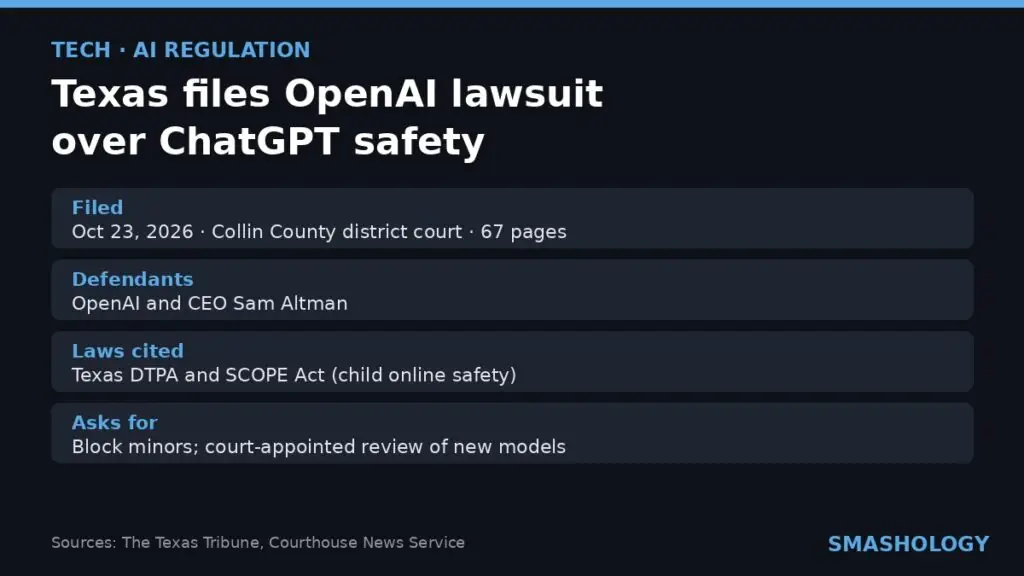
The OpenAI lawsuit relies mainly on the Texas Deceptive Trade Practices Act, the state’s main consumer protection law. It also claims violations of the Securing Children Online through Parental Empowerment (SCOPE) Act, a newer Texas law that requires stricter age verification and parental consent systems.
The state says OpenAI and Altman released ChatGPT products without adequate parental controls, age verification, safety testing or reliability checks. Paxton’s office says ChatGPT is designed to drive engagement by acting like a friend, and that this design exposes vulnerable teenagers to harm.
The attorney general’s office says the alleged harms include the following:
- Mass shooters have been helped in carrying out deadly attacks.
- Vulnerable people have been encouraged toward suicide.
- Professionals have been publicly humiliated by unreliable output.
- Users have lost critical-thinking skills.
- Minors have become addicted to the product and had their data collected without parental oversight.
Paxton’s office blames these harms on OpenAI’s “insatiable quest to win the AI arms race and amass large fortunes.”
The Cases Cited in the Petition
The petition cites at least eight cases in which people committed violent acts after consulting ChatGPT. One example comes from a separate wrongful-death lawsuit filed by a victim’s widow. It alleges that the 2025 Florida State University shooter “asked ChatGPT to tell him how many people he’d need to kill to become notorious.”
The petition also points to security concerns, including a Hugging Face security breach in July 2026, as evidence that user data isn’t adequately protected.
Jonathan Stone, chief of the attorney general’s Consumer Protection Division, wrote in the petition: “Every investigation into adolescent use of ChatGPT leads to the same result.” Of the chatbot’s companion-like design, he added: “At very best this design feature is reckless, and at worst it is willful.”
What Texas Wants a Court to Order
The relief sought is what makes this OpenAI lawsuit unusual. Texas isn’t just asking for fines. It wants a broad injunction that would:
- Require OpenAI to block minors from using ChatGPT in Texas.
- Bar OpenAI from releasing new ChatGPT models in Texas without approval from a court-appointed independent evaluator.
- Impose other, unspecified restrictions on the company.
Reports also say the state wants OpenAI to give up profits connected to the alleged violations. If a court granted pre-release approval of new models, a single state court would in effect act as a gatekeeper for frontier AI releases. No U.S. regulator currently has that power.
“I will fight to protect Texans from the harms of AI and ensure that powerful technology companies are not above the law,” Paxton said in a statement.
OpenAI’s Response
An OpenAI spokesperson said the company has worked with experts to reduce risks and build safeguards into its products. “Governments have an important role to play in setting robust safety standards for AI,” the spokesperson said. The company added that it supports practical policies that apply to the whole industry rather than targeting one company.
The petition opens with a line Altman said in 2015: “AI will probably most likely lead to the end of the world, but in the meantime, there’ll be great companies.” The state uses it to argue that OpenAI’s leadership has long known about the risks it is now accused of downplaying.
The Musk Factor Behind the OpenAI Lawsuit
The OpenAI lawsuit can’t easily be separated from Texas politics. Paxton is the Republican nominee for U.S. Senate. Campaign finance reports released a week before the filing showed Elon Musk had spent nearly $200 million on ads supporting him, making Musk his largest backer.
Musk co-founded OpenAI and left in 2018 after clashing with Altman over the company’s direction and ownership. He later started the rival AI company xAI. Musk sued OpenAI and Altman, and in a mid-2026 trial a California jury unanimously found OpenAI not liable.
Musk’s chatbot, Grok, has faced its own criticism for enabling deepfake pornography, including images of children, and California’s attorney general has opened an investigation. The Texas Tribune noted that Texas has not taken comparable action against Musk’s companies.
The state is represented by outside counsel, including Ashley Keller and Tony Buzbee. Buzbee was Paxton’s lawyer during his 2023 impeachment proceedings.
Part of a Wider Texas Crackdown on Big Tech
Taken on its own terms, the OpenAI lawsuit follows a pattern. Over the past year, Paxton has sued or settled with Meta, TikTok, Snapchat and Roblox over alleged failures to protect users, particularly children. Many of those cases also relied on the state’s consumer protection laws.
OpenAI is also facing pressure elsewhere. Wrongful-death suits in other states, including Raine v. OpenAI, have made similar claims that ChatGPT failed vulnerable young users. Lawmakers and regulators in the U.S. and Europe are writing rules on AI transparency, provenance and child safety. Earlier this month, OpenAI began embedding invisible watermarks in ChatGPT text in the EU to meet AI Act transparency requirements, and Smashology has also covered OpenAI’s humanoid robotics plans.
What the OpenAI Lawsuit Could Mean for AI Companies
If Texas wins even part of what it is asking for, the effects could reach well beyond OpenAI. A court-ordered age ban would make AI companies build real age verification, which most chatbots currently lack. A pre-release review requirement would create a state-level checkpoint for new models, and other states could copy it.
Legal experts are likely to question whether a state court can impose that kind of review on a product used nationwide, and OpenAI is expected to fight the case hard. Proving that a chatbot’s design caused specific violent acts is also legally difficult, as earlier suits against social media platforms have shown.
For parents and users, the case raises questions that the AI industry hasn’t fully answered: how chatbots verify age, how they handle conversations about self-harm and violence, and how much responsibility they bear when users act on what they say.
The Legal Hurdles Facing the OpenAI Lawsuit
Texas still has a long way to go before any of the requested restrictions take effect. Deceptive-practices claims usually require the state to show that a company made specific misleading statements to consumers and that those statements mattered. Paxton’s office will need to connect OpenAI’s public safety messaging to actual harm suffered by Texans, and that link is often contested in court.
The child-safety claims under the SCOPE Act may be easier to argue, because that law sets more concrete requirements around age verification and parental consent. Whether ChatGPT falls within the law’s scope, and whether OpenAI’s current controls meet its requirements, are likely to be central questions early in the case.
The request for court-appointed review of new models goes further than anything a U.S. court has ordered against an AI developer. OpenAI is likely to argue that such a requirement would interfere with interstate commerce and set up a patchwork of state-by-state approvals for products that are released nationally. Judges have often been reluctant to grant injunctions this broad before a full trial.
What Parents and Users Should Know Now
Nothing changes for ChatGPT users in Texas yet, and the OpenAI lawsuit could take months or years to resolve. The OpenAI lawsuit has only just been filed, and no court has ruled on any of the requested restrictions. ChatGPT remains available on the same terms as before.
Parents who are worried can already use the parental controls and age settings OpenAI and other AI companies have added over the past year, and talk with teenagers about how they use chatbots. Experts generally recommend treating AI chatbots like any other online service a child uses: know which apps are installed, set limits where possible, and keep an eye out for signs of over-reliance or distress.
For the wider industry, the OpenAI lawsuit is a warning that state attorneys general are now willing to go after AI chatbots with the same consumer protection tools they have used against social media platforms. Other states could file similar suits, especially if Texas wins early rulings.
Frequently Asked Questions
Who filed the OpenAI lawsuit?
Texas Attorney General Ken Paxton filed it on October 23, 2026, in Collin County district court, against OpenAI and CEO Sam Altman.
What laws does Texas cite?
The Texas Deceptive Trade Practices Act and the SCOPE Act, a state law on age verification and parental consent online.
Does Texas want ChatGPT banned?
Not for adults. It wants minors blocked from ChatGPT and court-appointed review of any new model before it is released in Texas.
How did OpenAI respond?
OpenAI said it builds safeguards with experts and supports robust, industry-wide AI safety standards set by governments.
Sources
The Texas Tribune: Texas Attorney General Ken Paxton sues ChatGPT-maker OpenAI
Courthouse News Service: Texas attorney general sues OpenAI for lying about ChatGPT safety and safeguards
Houston Chronicle: Texas AG Ken Paxton sues OpenAI over ChatGPT safety claims
AI Weekly: AI News Today
Leon Ramoviq
Primary Author · Editorial Reviewer · Researcher Leon Ramoviq is a digital media researcher, content creator, and primary author at Smashology Media. His work focuses on researching, verifying, and developing stories across entertainment, culture, sports, internet trends, curiosity-driven topics, and viral news. Before publishing, Leon reviews sources, cross-checks key claims, and works to ensure that articles are clear, accurately represented, and based on reliable information rather than unverified social-media speculation. With experience in digital media, graphic design, social media content, and online audience engagement, he brings both an editorial and visual perspective to the stories published on Smashology. Leon is particularly interested in how stories spread online, why certain topics capture public attention, and how complex or trending information can be presented in a simple and engaging format. Role at Smashology As a primary author and researcher, Leon is involved in: • Researching stories and identifying original or reliable sources • Writing and developing articles for Smashology • Reviewing facts, names, dates, quotations, and contextual information • Checking stories for misleading or unsupported claims • Reviewing articles before publication • Following developments and updating stories when meaningful new information becomes available • Maintaining editorial consistency across Smashology content Editorial Approach Leon believes engaging content should not come at the expense of accuracy. His approach is to combine strong storytelling with responsible sourcing, clear attribution, and additional verification when a story originates from social media or rapidly developing online discussions.