The Milwaukee Brewers beat the Tampa Bay Rays 3-2 in World Series Game 1 on Friday, October 23, 2026, at American Family Field. They hung on through a tense ninth inning to take a 1-0 lead in the series. Jacob Misiorowski set a record with his first pitch, Christian Yelich and William Contreras drove in runs in the first inning, and closer Trevor Megill got the final out with the bases loaded after a replay review kept the Rays alive.
Whichever team wins, this World Series will produce a first-time champion. The Brewers have never won the title, and neither have the Rays.
World Series Game 1: How the Brewers Won
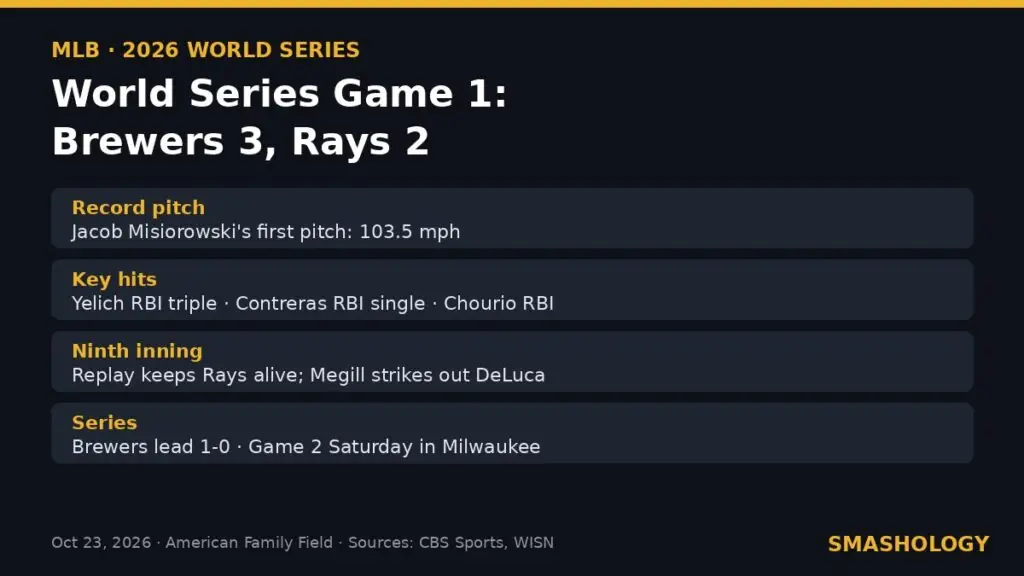
Milwaukee scored first. In the bottom of the first inning, Yelich drove in the opening run with a triple off Rays starter Nick Martinez, and Contreras followed with a run-scoring single. The two hard-hit balls gave Milwaukee a 2-0 lead before Tampa Bay had settled in.
Martinez was very good after that. He finished with five innings, five strikeouts and no walks, and the two first-inning runs were the only ones he allowed. He was still charged with the loss.
The Rays got one back in the fourth. Liam Hicks grounded out to drive in Jonathan Aranda, cutting the lead to 2-1. Tampa Bay’s chances later in the game were cut short by its own mistakes. Victor Mesa Jr. was thrown out trying to steal third with two outs while Yandy Díaz was batting.
Milwaukee added an important insurance run in the seventh. With two outs, Jackson Chourio drove in Cooper Pratt to make it 3-1. That run turned out to decide the game.
Misiorowski’s Record First Pitch
The night began with a record. Brewers starter Jacob Misiorowski’s first pitch reached 103.5 mph, which MLB says is the fastest pitch in World Series history in the pitch-tracking era.
Misiorowski went five innings and allowed one run on four hits, with three strikeouts and one walk. That was enough to hand a lead to one of the best bullpens left in the postseason.
Abner Uribe, Aaron Ashby and Trevor Megill combined to allow one run over the last four innings. Ashby pitched two scoreless innings in the middle of the game, keeping the Rays quiet while Milwaukee looked for more runs.
A Dramatic Ninth Inning in World Series Game 1
The ending was the most dramatic part of World Series Game 1. Leading 3-1, Megill loaded the bases with one out in the ninth. Tampa Bay then hit into what looked like a game-ending double play.
The Rays challenged, and replay showed that Cooper Pratt’s foot had come off second base. The call was overturned, a run scored to make it 3-2, and the game continued with the tying run in scoring position.
Megill then struck out Jonny DeLuca to end it. The crowd at American Family Field had gone from celebrating to anxious and back again in a few minutes.
Winners and Losers From Game 1
William Contreras stood out. The Brewers catcher went 2-for-3 with a walk and an RBI. He also blocked several breaking balls in the dirt in the ninth and won two ABS challenges that turned balls into strikes, small moments that add up in a one-run game.
The Milwaukee bullpen held a two-run lead for four innings against a lineup that had been hitting well in October.
On the other side, the bottom of Tampa Bay’s order struggled badly. Hitters five through nine, including a pinch-hitter, went 1-for-17 with six strikeouts. The Rays were 0-for-6 with runners in scoring position, and that was the main reason they lost a game in which their starter pitched well.
How the Brewers and Rays Reached the World Series
Milwaukee’s run to the World Series was one of the most dominant of the postseason. The Brewers beat the San Diego Padres 3-1 in the NL Division Series, then swept the defending champion Los Angeles Dodgers 4-0 in the NLCS. This is their first World Series since 1982, when they lost to the St. Louis Cardinals in seven games.
Tampa Bay swept the New York Yankees 3-0 in the AL Division Series, then beat the Cleveland Guardians in a six-game ALCS. As Smashology reported, the Rays clinched the pennant with a 7-3 win in Game 6. The Rays are 0-2 in previous World Series appearances, so a title in either Milwaukee or Tampa Bay would end a long wait.
What World Series Game 1 Means Historically
History favours the team that wins the opener. Teams that win Game 1 of a best-of-seven series have gone on to win it about 64.5% of the time. Teams that win Game 1 at home have won 68.4% of the time.
The Brewers now join that group of World Series Game 1 winners. Those numbers aren’t a guarantee, but they show how much a home win in World Series Game 1 helps. Milwaukee now leads the series and will try to go 2-0 before it moves to Tampa Bay.
Why the Replay Call in World Series Game 1 Mattered
The replay review in the ninth will be talked about for days. Before it, the Brewers were celebrating what looked like a game-ending double play. After it, the Rays had cut the lead to one with runners on base and a chance to win.
The call itself was clear on replay: Pratt’s foot came off second base before the ball arrived, so the runner was safe. It was a reminder that in the replay era, a game isn’t over until the review is done. It also put Megill in the hardest spot of the night, needing one more out with the stadium tense and the series opener at stake.
Megill handled it. Getting DeLuca to strike out ended the threat and gave Milwaukee the win, but the inning showed how fragile a one-run lead can be at this stage of the season.
Tampa Bay’s Missed Chances
The Rays will look back on World Series Game 1 as a game they could have won. Martinez kept them close after the first inning, and they had chances to tie it. The 0-for-6 with runners in scoring position stands out, as does Mesa Jr. being thrown out at third, which ended a promising inning.
Tampa Bay has relied all postseason on pitching and timely hitting. In the ALCS, its hitters came through in key moments, including big innings in Games 4 and 6 against Cleveland. In Game 1 against Milwaukee, the timely hit never came. If Tampa Bay can get production from the bottom of its lineup, the series could tighten quickly.
Milwaukee’s Formula Is Working
For the Brewers, World Series Game 1 followed the same pattern as their sweep of the Dodgers. They scored early, got solid innings from the starter, and let the bullpen finish. Contreras’s work behind the plate, including his blocks in the dirt and his ABS challenges, shows the attention to detail that has carried Milwaukee through October.
Home-field advantage also mattered in World Series Game 1. American Family Field was loud from the first pitch, and the Brewers now have a chance to win twice at home before the series heads to Florida.
Game 2 Preview and Full Schedule
Game 2 is on Saturday, October 24, at American Family Field, with first pitch shortly after 8 p.m. ET on Fox. Logan Henderson starts for the Brewers and Drew Rasmussen for the Rays.
The rest of the schedule, with all games at 8 p.m. ET on Fox:
- Game 3: Monday, October 26, at Tampa Bay
- Game 4: Tuesday, October 27, at Tampa Bay
- Game 5 (if necessary): Wednesday, October 28, at Tampa Bay
- Game 6 (if necessary): Friday, October 30, at Milwaukee
- Game 7 (if necessary): Saturday, October 31, at Milwaukee
The series can also be streamed on Fubo and DIRECTV and heard on SiriusXM.
Players to Watch in the Rest of the Series
For Milwaukee, Yelich and Contreras look locked in at the plate, Chourio keeps producing in big moments, and the bullpen trio of Uribe, Ashby and Megill gives Milwaukee a lot of options late in games.
For Tampa Bay, Aranda has been one of the team’s most consistent bats this October, and the Rays need more from the bottom of the order. Martinez’s strong five innings after the first suggest the rotation can keep them close. Whether Tampa Bay can come back may depend on how its hitters handle Milwaukee’s power pitching in the next two games.
Frequently Asked Questions
Who won World Series Game 1?
The Milwaukee Brewers beat the Tampa Bay Rays 3-2 on October 23, 2026, at American Family Field.
What record did Jacob Misiorowski set?
His first pitch reached 103.5 mph, the fastest pitch in World Series history in the pitch-tracking era.
When is World Series Game 2?
Saturday, October 24, 2026, at about 8 p.m. ET on Fox. Logan Henderson faces Drew Rasmussen.
Have the Brewers or Rays ever won the World Series?
No. Both teams are looking for their first championship, so 2026 will produce a first-time winner.
Sources
CBS Sports: Winners and losers from World Series Game 1
WISN: Brewers beat Rays in Game 1 of World Series, 3-2
Bleacher Report: Brewers survive Rays rally to win Game 1
Yahoo Sports: World Series schedule 2026
NPR: Rays will face Brewers in World Series to produce a first-time champion
Leon Ramoviq
Primary Author · Editorial Reviewer · Researcher Leon Ramoviq is a digital media researcher, content creator, and primary author at Smashology Media. His work focuses on researching, verifying, and developing stories across entertainment, culture, sports, internet trends, curiosity-driven topics, and viral news. Before publishing, Leon reviews sources, cross-checks key claims, and works to ensure that articles are clear, accurately represented, and based on reliable information rather than unverified social-media speculation. With experience in digital media, graphic design, social media content, and online audience engagement, he brings both an editorial and visual perspective to the stories published on Smashology. Leon is particularly interested in how stories spread online, why certain topics capture public attention, and how complex or trending information can be presented in a simple and engaging format. Role at Smashology As a primary author and researcher, Leon is involved in: • Researching stories and identifying original or reliable sources • Writing and developing articles for Smashology • Reviewing facts, names, dates, quotations, and contextual information • Checking stories for misleading or unsupported claims • Reviewing articles before publication • Following developments and updating stories when meaningful new information becomes available • Maintaining editorial consistency across Smashology content Editorial Approach Leon believes engaging content should not come at the expense of accuracy. His approach is to combine strong storytelling with responsible sourcing, clear attribution, and additional verification when a story originates from social media or rapidly developing online discussions.