The UN climate loss-and-damage fund has provisionally earmarked $20 million for Nepal after August’s devastating floods. The decision creates a route toward support, but a funding proposal and approval remain necessary, while reconstruction needs run into billions of dollars.
What changed at the October 22 meeting
The board of the Fund for Responding to Loss and Damage has agreed to set aside $20 million for flood-stricken Nepal, according to AFP’s report carried by CNA. The decision was made at an extraordinary meeting on Thursday, October 22, and reported internationally on October 23. It marks a significant procedural step for a country facing enormous reconstruction needs, while leaving a crucial qualification: the allocation does not mean the money has already arrived.
AFP reports that Nepal must present a proposal for board approval before funding is released, with no firm timetable for that process. Nepal’s finance minister welcomed the commitment of grant support. The difference between a provisional reservation and a disbursement is central to understanding this announcement. The first gives a request a defined place in the fund’s process; the second would establish that resources are actually available to be spent.
Reuters, reporting from Kathmandu, separately quoted Nepal’s government confirming the support and described damage to roads, bridges, schools and hydropower infrastructure. Its report put initial reconstruction needs above $4.7 billion. These accounts corroborate the funding development, but a headline saying Nepal has already received a completed cash transfer would go beyond the conditions described in the more detailed reporting.
The announcement should therefore be read as movement toward assistance rather than the completion of recovery. That distinction does not diminish the value of securing an allocation. It identifies the next event that matters: a proposal approved under the fund’s rules, followed by an identifiable release of money. For communities waiting for repairs, those stages are consequential in a way that the announcement alone cannot resolve.
How the proposal separates support, fees and approval
The board paper prepared for the extraordinary meeting provides the original procedural context. Dated October 15, it contains a draft decision proposing a $21.6 million set-aside, including $1.6 million in oversight fees, and inviting Nepal to submit a funding request outside the regular submission period. It is a preparatory document, not a published final decision, and should be labelled that way when used to explain the design.
This distinction also resolves a potential confusion over the amount. The proposed total in that paper includes an oversight component; the reported $20 million refers to the potential support for Nepal. Treating $21.6 million as an additional reconstruction grant, or adding it to the $20 million as a second award, would double-count the same proposed arrangement. The final operational details still need to be assessed against approved documentation.
The fund’s fifth-meeting decisions establishing the Barbados Implementation Modalities describe an initial set of interventions for 2025 and 2026 and a range of $5 million to $20 million for individual activities, projects and programmes. That start-up framework helps explain the scale of this request. It should not be mistaken for a statement that $20 million would cover the needs of every disaster, or that the same limit must define the fund’s permanent design.
The useful accountability question is what the pilot demonstrates. Can an exceptional request move through assessment and approval while retaining clear responsibility for spending? Can the board publish enough information for the public to distinguish a reservation, an approved project and a payment? Those are practical tests of the mechanism. A successful procedure would need to establish more than the willingness to hold an extraordinary meeting.
The funding gap is measurable, but the figures describe different things
The Indian Express reports initial economic loss and damage of at least $2.69 billion and recovery and reconstruction requirements of at least $4.71 billion. These are not interchangeable totals. The first estimates damage and losses from the disaster; the second concerns what recovery and rebuilding may require. Both are estimates, and neither becomes a final audited bill merely because it appears alongside a precise grant figure.
Using the $4.71 billion reconstruction estimate, $20 million is about 0.425% of the stated need. That calculation divides 20 million by 4,710 million. Put another way, the estimated reconstruction requirement is roughly 235 times the proposed support. The comparison explains why officials and observers can welcome the decision while still describing the available help as a small fraction of the challenge.
It would be wrong to infer that all remaining needs are necessarily unfunded, because reconstruction can draw on several sources. It would be equally wrong to assume that other announced support has already closed the gap. A useful financing account needs to identify each contribution, its purpose, conditions and payment status. Pledges, loans, domestic spending and grants cannot simply be added together without considering what each figure represents.
There is another reason to keep awards separate. A September 9 Kathmandu Post report described a different $20 million funding process based on earlier proposals, while explicitly distinguishing the urgent request after the August disaster. That earlier report should not be recycled as proof that Thursday’s emergency allocation was already paid in September. The same country and headline amount can refer to different applications.
What happened in August, and what the evidence says about its cause
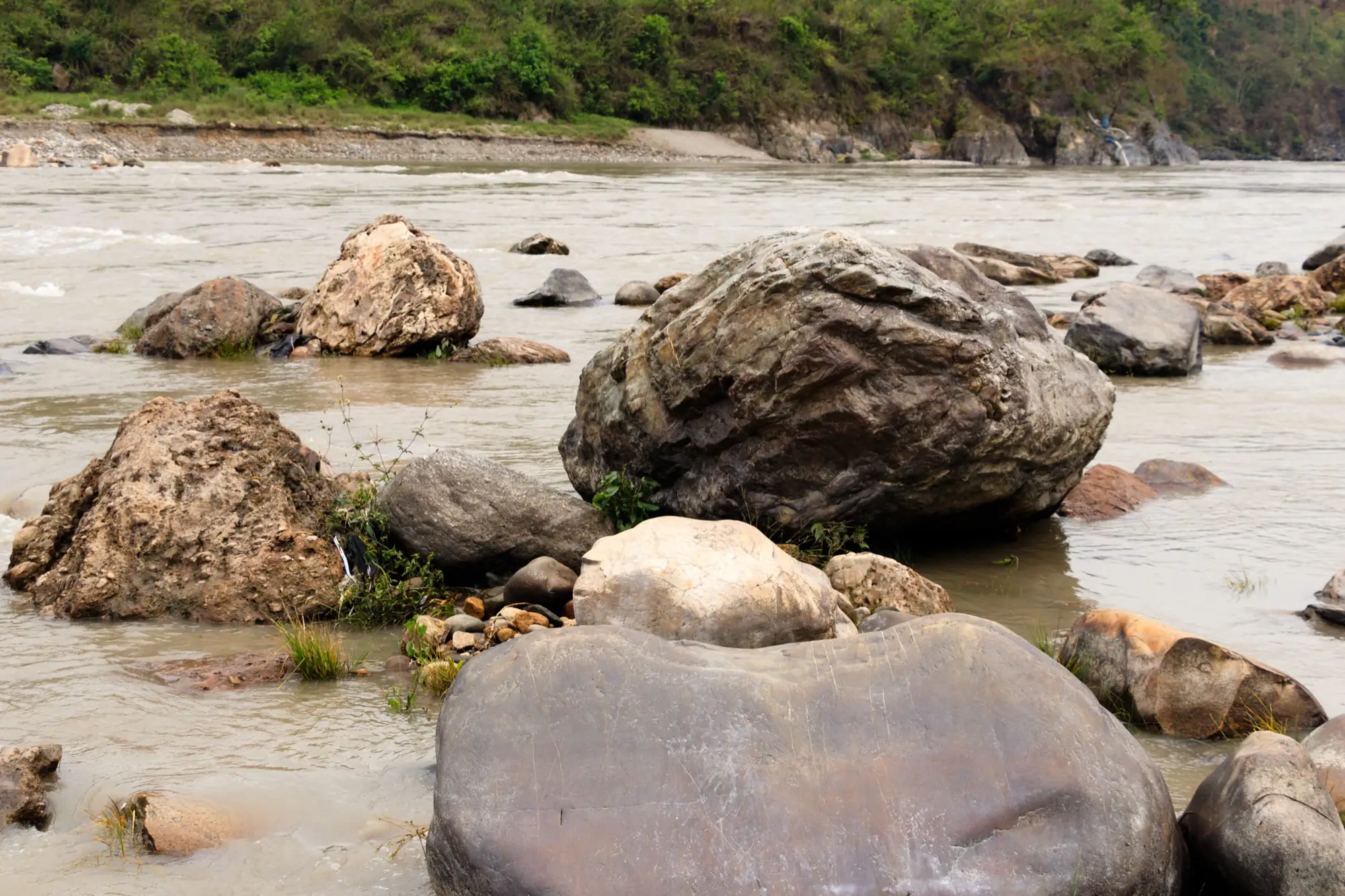
The UNESCO IHP-WINS account dates the disaster to August 26. It describes an ice-and-rock avalanche above the Lhende Khola, a tributary in the Bhote Koshi system, that blocked a river, formed a temporary lake and released a debris-laden surge when the blockage failed. The account links the cascade downstream into the Trishuli and Narayani rivers and notes that heavy rainfall had not preceded the event in the source area.
That mechanism matters because the word “flood” can conceal very different hazards. A downstream community can face a destructive surge without experiencing the intense local rain that residents might ordinarily associate with danger. An upstream blockage and sudden release can create a threat that is difficult to understand from the weather immediately outside a home. Reconstruction planning therefore needs to consider the linked watershed, not only the visibly damaged settlement.
NSET’s preliminary disaster analysis likewise describes the transformation of an ice–rock avalanche into a sediment- and water-laden flow. It says a seismic signal recorded near the source was generated by the mass movement itself, rather than establishing an earthquake trigger. That qualification prevents another misleading shortcut: a strong recorded ground signal does not automatically prove that a new earthquake initiated the collapse.
Climate attribution also needs care. A September 17 AP report on World Weather Attribution’s analysis describes warming-related glacier thinning and permafrost thaw as likely destabilising influences, while noting that climate change was not identified as the sole cause. The analysis also considered possible weakening from the 2015 earthquake. These findings support discussion of interacting pressures, rather than a single-cause account that the evidence does not establish.
Why the fund’s delivery process will remain under scrutiny
The United Nations account of COP28’s opening agreement records the fund’s operationalisation in November 2023 as a major step in assistance for vulnerable countries facing climate-related loss and damage. Thursday’s Nepal decision brings that institutional promise into a specific disaster response. The question now is how the mechanism translates an international commitment into an approved, usable programme.
UNESCO’s rapid-response assessment adds an important distinction for rebuilding: monitoring equipment in the upper Bhote Koshi corridor was damaged or destroyed, while warning arrangements designed around ordinary monsoon and river flooding did not identify the cryospheric trigger in time. A warning network can therefore require both physical repair and a reassessment of the hazards it is expected to detect. Restoring the previous equipment would not, by itself, demonstrate that this different failure mechanism had been addressed.
That distinction matters when judging future project proposals. A completed installation is a tangible output; a warning that reaches people early enough to act is the intended result. Evaluating the latter requires evidence about detection, communication and local response. These are questions for the eventual programme documentation, rather than claims that a particular technical solution has already been funded.
There are two legitimate measures of progress. One is institutional: the fund has demonstrated that its board can convene around an urgent country request. The other is practical: affected people need services, livelihoods and infrastructure restored. These measures are related, but a favourable outcome on the first cannot be reported as a completed outcome on the second. Tracking both is a way to assess delivery without dismissing procedural progress as meaningless.
A reconstruction proposal would also need to make priorities intelligible. Reopening a transport connection, restoring electricity and repairing a school address different consequences of the same disaster. This article does not claim that any of those projects has been selected for the new allocation. They illustrate why the eventual project description, implementing arrangements and spending milestones will matter as much as the headline amount.
The next verified update should identify what Nepal submits, what the board approves and when disbursement occurs. Those records would allow the provisional decision to be followed through its consequences. They would also show what lessons the emergency approach offers for future requests, without assuming in advance that a one-off pilot settles the fund’s long-term operating model.
Readers can follow our News coverage for further confirmed developments. For now, the defensible conclusion is specific: Nepal has gained a provisional route to $20 million in climate-disaster support, against reconstruction estimates measured in billions. The importance of the decision lies in that opening; its practical impact will depend on the approval and delivery steps still ahead.
Sources and further reading
- AFP / CNA: provisional allocation and conditions
- Reuters / ThePrint: Nepal government confirmation
- FRLD: October 15 preparatory board paper
- FRLD: Barbados Implementation Modalities decisions
- The Indian Express: allocation and reconstruction estimates
- The Kathmandu Post: separate earlier funding process
- UNESCO IHP-WINS: August 26 flood mechanism
- NSET: preliminary avalanche and flood analysis
- AP: September climate-attribution findings
- United Nations: COP28 fund operationalisation
Smashology Editorial Team
The Smashology Editorial Team is responsible for reviewing and publishing content at Smashology Media, overseeing sourcing, fact-checking, corrections, and editorial standards across coverage of internet culture, technology, entertainment, news, and crime.
Sources
Links cited in this article.
- Original photographcommons.wikimedia.org
- CC BY-SA 4.0creativecommons.org
- AFP’s report carried by CNAchannelnewsasia.com
- Reuters, reporting from Kathmandutheprint.in
- board paper prepared for the extraordinary meetingfrld.org
- fifth-meeting decisions establishing the Barbados Implementation Modalitiesfrld.org
- The Indian Express reportsindianexpress.com
- September 9 Kathmandu Post reportkathmandupost.com
- UNESCO IHP-WINS accountihp-wins.unesco.org
- NSET’s preliminary disaster analysisnset.org.np
- September 17 AP report on World Weather Attribution’s analysisapnews.com
- United Nations account of COP28’s opening agreementunitedarabemirates.un.org