A coyote leaping toward fruit in a trail-camera video is drawing fresh coverage. The original Facebook reel is traceable to Tom Miranda, but its camera overlay shows September 25; the clip illustrates an established fact about coyotes rather than a newly discovered feeding habit.
A coyote’s attempt to reach fruit hanging from a tree is attracting another round of attention online. The clip is entertaining on its own terms: a wild animal looks upward, springs toward a branch and turns an ordinary food search into a memorable nighttime scene. It also offers a useful chance to separate what a viral video actually shows from the wider claims that can accumulate as it is reposted.
Smashology traced the embed used in recent coverage to a public Facebook reel shared by Tom Miranda, carrying the caption “Coyote eating pears!” The visible footage shows the animal beneath a fruit-bearing tree and jumping toward a branch. The camera overlay reads September 25, 2026. That display is not independent verification of the camera’s clock, but it is a clear reason not to describe the scene as newly filmed on October 22 or 23.
Coyote video: the verified source and the missing details
The original page establishes a traceable uploader and caption, rather than merely a screenshot circulating without attribution. It does not, on the material reviewed, independently establish where the scene was recorded, who installed the camera or whether its displayed date is accurate. Those details should remain unknown unless the creator or another reliable source supplies evidence. A recent article’s publication date is a different fact from the date on which an animal passed a camera.
The clip also does not provide a calibrated measurement of the jump. It is tempting to turn an eye-catching leap into a numerical claim about height, but a branch in a fixed-camera view is not a measuring scale. Perspective, distance and the animal’s position all matter. We are therefore not assigning a height, calling this a record or presenting the footage as an experiment measuring coyote athletic performance.
The attribution check is similarly limited. Seeing a public original reel confirms where the cited version was shared; it does not amount to a forensic examination of every frame or proof of the circumstances before and after the recording. The responsible description is a traceable video of apparent fruit foraging, with its remaining provenance gaps stated. There is no need to invent a location or a dramatic backstory for the scene to be interesting.
Why the clip is circulating now
Whiskey Riff covered the footage on October 21 and embedded the same Miranda reel. Its account describes an unsuccessful first attempt followed by another leap. Other coverage appeared on October 22, while a Sunday Guardian article carries an October 23 update in India’s time zone. Those dates explain fresh editorial attention without establishing a fresh recording date.
Several outlets discussing the same reel do not constitute several independent recordings. Repetition can confirm that a clip is receiving coverage, but it cannot fill gaps in its original location or timing. We are also not using likes, comments or shares as a verified count of individual viewers. Engagement counters can change, may represent different actions and do not by themselves establish how many people watched the full video.
Part of the appeal is the mismatch between the familiar image of a predator and the sight of fruit being targeted overhead. That surprise belongs to the viewer’s expectations. It does not mean scientists have just discovered that coyotes eat plants, nor does it show the animal abandoning its usual diet. Understanding the established biology makes the scene more informative without making it any less watchable.
Fruit is already part of the coyote’s diet
The National Park Service’s coyote information lists small mammals among the species’ foods, alongside fish, frogs, insects, snakes, deer, fruit and grass. Coyotes are opportunistic feeders. The presence of fruit in a diet that also includes animal prey is therefore consistent with existing wildlife guidance. One short clip can illustrate that flexibility, but it cannot tell us the complete diet of the individual on screen.
The useful distinction is between an observation and a generalization. The observation concerns an animal pursuing one available food item. A claim that coyotes in a particular region now eat mostly pears would require broader evidence, collected across animals and time. The footage supplies neither a representative sample nor a comparison with previous seasons. It should not be used to support such a population-level conclusion.
Diet is also not a personality test. Calling the animal friendly because it reaches for fruit would be as misleading as assuming every appearance near a house signals aggression. Food choice tells viewers what the animal is attempting at that moment. It does not establish that approaching, feeding or trying to touch the animal would be safe.
Different habitats offer different opportunities
At Death Valley National Park, the National Park Service describes coyotes eating rabbits and rodents as well as other available foods, including prickly pear fruit, dates and grapes. Prickly pear is a cactus fruit and should not be confused with the hanging tree fruit identified in Miranda’s caption. The park’s account nevertheless gives another documented example of plant foods appearing in coyote diets.
The same source describes coyotes across varied habitats, from low desert areas to mountain forests, and notes that activity can occur by day as well as at night. That flexibility helps explain why a simple predator-versus-fruit contrast is incomplete. Animals make use of food available in their surroundings. Different places and seasons can offer different combinations without representing a sudden change in the species itself.
None of that locates this particular video in Death Valley. The park’s information is background about the species, not evidence of where Miranda’s footage originated. Keeping those two roles separate prevents a common viral-story error: placing a well-sourced fact about an animal next to an unverified clip and accidentally implying that the source authenticated its setting.
Why diet percentages need context
Rutgers Cooperative Extension’s coyote bulletin describes dietary flexibility and research on the foods coyotes consume. Such research can be useful background, but percentages need their original method and denominator. A figure representing how often a food occurs in examined samples is not automatically the same as its share of all calories, food weight or individual meals. Different categories can also appear within the same sample.
For this reason, this article does not copy a social-media diet chart and present it as a universal menu. A finding from one study area should not be applied automatically to every coyote in North America, still less to an animal whose filming location is unconfirmed. The sounder conclusion is the narrower one supported by multiple wildlife agencies: coyotes can eat both animal and plant foods, including fruit.
This is a useful habit beyond wildlife coverage. Whenever a striking percentage accompanies a viral post, ask what was counted, where the data came from and what the sample represents. A number may be accurate in its original setting and misleading when detached from it. The pear clip does not need a dramatic statistic to establish its central point.
A backyard food source can affect a neighbourhood
The Oregon Department of Fish and Wildlife says coyotes can use urban as well as natural landscapes, with food sources including rodents, fruit, pet food, birdseed and waste. It recommends removing attractants such as fallen fruit and unsecured garbage. Its guidance also says that simply seeing a coyote in daylight does not establish that the animal is sick. Behaviour and context matter more than a simplistic day-versus-night assumption.
That guidance provides a practical connection to the video. A fruit tree can be a source of food, but the clip does not establish that someone deliberately fed or baited this animal. Viewers should not add that allegation. At home, the separate preventive lesson is to avoid making food repeatedly available in ways that draw wildlife close to people, pets and buildings.
The Arizona Game and Fish Department likewise describes coyotes as omnivores and warns about food conditioning and habituation. It notes that a six-foot fence does not necessarily provide protection because coyotes can jump well. Its recommendations include supervising small pets, using secure roofed enclosures where appropriate and keeping dogs on a leash. The pear footage is not a test of any particular fence or enclosure.
A shared response makes more sense than treating each yard in isolation. If one property supplies an accessible food source, animals are not obliged to remain within that property’s boundary. That is the reasoning behind the agency’s emphasis on neighbourhood awareness. It is a coexistence issue, rather than a reason to label every coyote sighting an emergency.
Enjoy the footage without recreating the encounter
Michigan’s Department of Natural Resources coyote guidance also addresses food availability and seasonal behaviour. Its broader message is compatible with the other agencies: do not deliberately feed or attempt to tame a wild coyote. A clip can be amusing while the animal remains wild and deserving of distance. Creating another video is not a reason to offer food or bring pets closer.
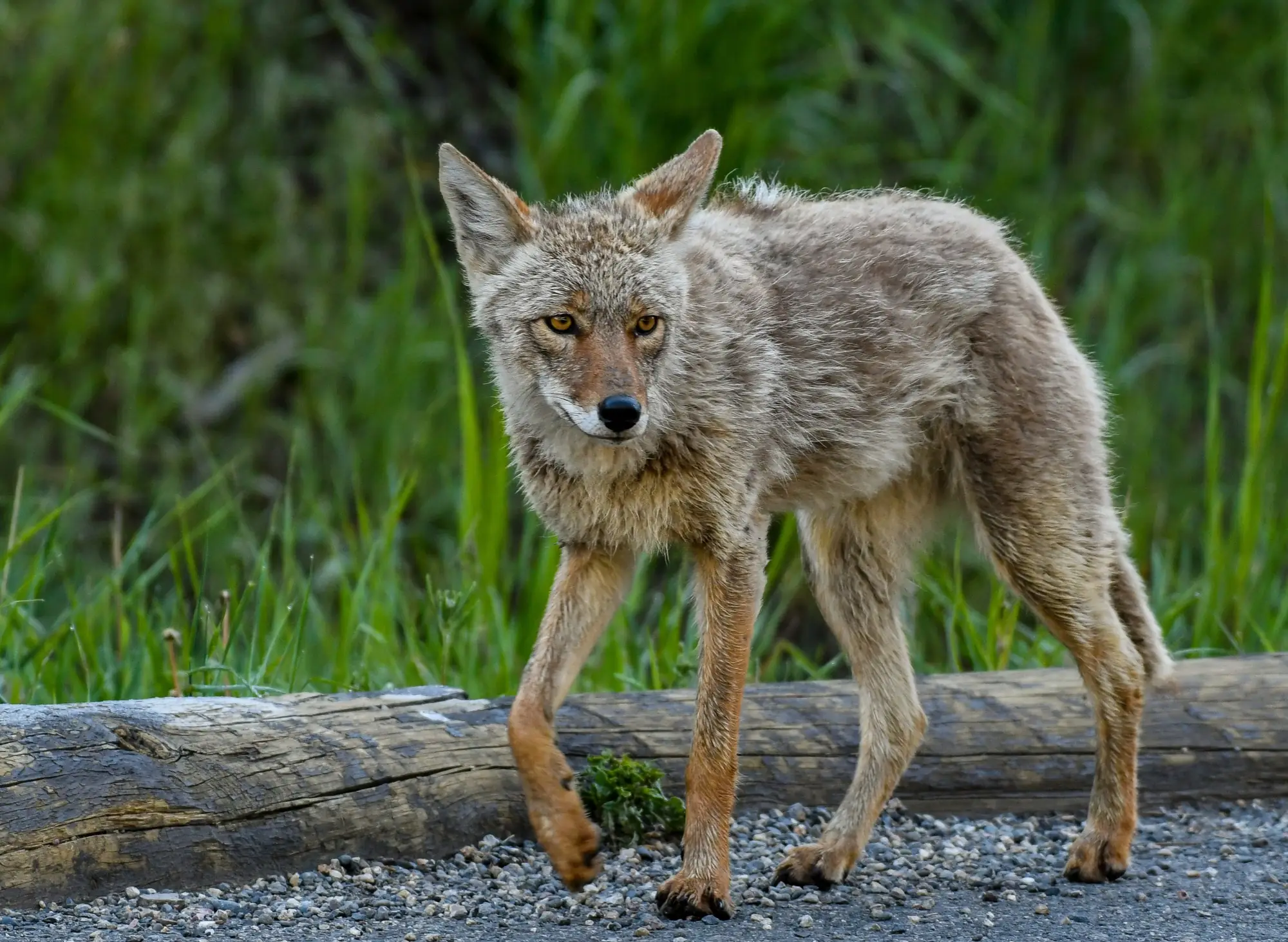
The archive photograph accompanying this article is separately credited to the National Park Service and dated June 23, 2019, at Yellowstone. It is not a still taken from Miranda’s reel and does not establish the reel’s location. Readers who want to examine the actual footage can follow the original Facebook link above. Keeping the image and video provenance visible helps avoid manufacturing evidence through illustration.
For more coverage that checks online claims against their sources, visit our Viral section. The most interesting verified point here is modest: a traceable coyote video offers an unusually clear and entertaining illustration of flexible foraging. The recent coverage is real; the filming date and setting remain less certain. The wildlife context is well established, and the appropriate way to appreciate it is from a distance.
Smashology Editorial Team
The Smashology Editorial Team is responsible for reviewing and publishing content at Smashology Media, overseeing sourcing, fact-checking, corrections, and editorial standards across coverage of internet culture, technology, entertainment, news, and crime.
Sources
Links cited in this article.
- Original photograph and public-domain recordnpgallery.nps.gov
- Facebook reel shared by Tom Mirandafacebook.com
- Whiskey Riff covered the footage on October 21whiskeyriff.com
- Sunday Guardian articlesundayguardianlive.com
- National Park Service's coyote informationnps.gov
- Death Valley National Parknps.gov
- Rutgers Cooperative Extension's coyote bulletinextension.rutgers.edu
- Oregon Department of Fish and Wildlifemyodfw.com
- Arizona Game and Fish Departmentazgfd.com
- Department of Natural Resources coyote guidancemichigan.gov