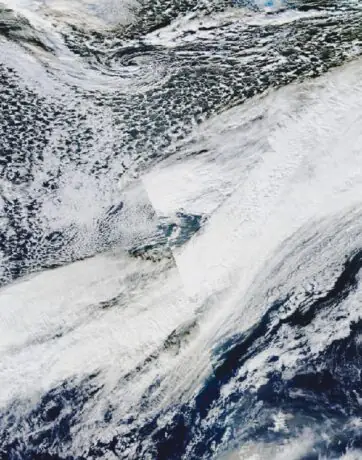
NASA’s Neil Gehrels Swift Observatory is collecting science data again after spending months in a low-drag configuration intended to preserve its orbit for an experimental servicing mission.
The agency said on August 28 that Swift’s Ultraviolet/Optical Telescope and X-ray Telescope were switched back on two days earlier. Both instruments had been turned off in February so the spacecraft could reduce atmospheric drag while teams prepared for a commercial spacecraft to approach, capture and raise its orbit.
That boost will no longer take place. NASA and Katalyst Space announced on August 19 that the company’s LINK servicing spacecraft would not attempt to capture or lift Swift after encountering problems controlling its orientation in orbit. LINK is still expected to try rendezvous and proximity operations, allowing the mission to test some technologies that could support future satellite servicing.
The change leaves Swift with a shorter operating horizon, but it also gives astronomers another opportunity to use a veteran observatory that has supported high-energy astrophysics for more than two decades.
Two instruments are back; a third is still being restored
Swift carries three main science instruments. NASA says the Ultraviolet/Optical Telescope and X-ray Telescope returned to operation on August 26. The X-ray instrument quickly produced a new observation of Tycho’s supernova remnant, a stellar debris field about 13,000 light-years away in the constellation Cassiopeia.
The Burst Alert Telescope, which detects gamma-ray bursts across a wide portion of the sky, remains offline for now. Its use was halted in April to save power and allow Swift’s solar panels to be positioned for lower drag. NASA says the mission team is working to return that instrument to data collection in the coming weeks.
That distinction matters because Swift’s value comes from the way its instruments work together. The satellite can detect a brief high-energy event, turn rapidly toward it and study the same target in X-ray, ultraviolet and visible light. It also sends alerts to observatories on Earth and in space so they can begin follow-up observations while a transient event is still unfolding.
Gamma-ray bursts can last from fractions of a second to minutes, but their afterglows can remain visible for much longer. Rapid coordination gives scientists a better chance to reconstruct what produced an explosion and how its energy moved through the surrounding environment.
Why Swift’s orbit became a problem
Swift launched in 2004 with a two-year primary mission. It has continued operating for 21 years, far beyond that original design period, and has become a flexible observatory for gamma-ray bursts, supernovae, black holes and other changing objects.
Unlike some spacecraft, Swift does not have a propulsion system capable of regularly raising its orbit. Even in low Earth orbit, the upper atmosphere produces a small amount of drag. Solar activity can heat and expand the atmosphere, increasing that drag at satellite altitudes.
NASA said heightened solar activity caused Swift to descend faster than expected. The agency contracted Katalyst Space in September 2025 to design, build, launch and operate a robotic servicing spacecraft on an unusually short schedule. LINK launched on July 3 aboard a Northrop Grumman Pegasus XL rocket, but later developed attitude-control problems.
NASA’s August 19 update said LINK would not proceed with the most demanding part of the mission: capturing Swift and boosting it to a higher orbit. The remaining proximity demonstration could still provide useful engineering data, but it will not extend Swift’s orbit.
What happens next
NASA previously estimated that Swift’s low-drag configuration could keep the observatory above 300 kilometers, or about 185 miles, until October. Below that altitude, operating the telescope becomes more difficult and the rate of descent increases.
With two science instruments active again, NASA now expects Swift to reach that 300-kilometer threshold within one to two months. The agency has not announced a new boost plan in its latest update.
The result is a trade-off. Returning to science may shorten the time Swift can remain in its lowest-drag posture, but it allows the observatory to use the time it has left for research. Restoring the Burst Alert Telescope would bring back the instrument most directly associated with Swift’s rapid alerts, although NASA has not provided an exact activation date.
For readers, the key point is that Swift has resumed part of its normal science mission, but it has not received an orbital rescue. The servicing spacecraft will remain separate, and the planned capture and boost have been canceled.
The episode also shows both the promise and difficulty of servicing satellites that were not originally designed to be refueled or moved. Even without a completed boost, lessons from LINK’s development, launch and planned proximity work could shape future attempts to inspect or assist aging spacecraft.
NASA says it will continue publishing operational updates on the Swift mission blog.
Sources
- NASA: Swift Restarts Science Observations, August 28, 2026.
- NASA: Updates Next Steps for Commercial Swift Boost Mission, August 19, 2026.
Leon Ramoviq
Primary Author · Editorial Reviewer · Researcher Leon Ramoviq is a digital media researcher, content creator, and primary author at Smashology Media. His work focuses on researching, verifying, and developing stories across entertainment, culture, sports, internet trends, curiosity-driven topics, and viral news. Before publishing, Leon reviews sources, cross-checks key claims, and works to ensure that articles are clear, accurately represented, and based on reliable information rather than unverified social-media speculation. With experience in digital media, graphic design, social media content, and online audience engagement, he brings both an editorial and visual perspective to the stories published on Smashology. Leon is particularly interested in how stories spread online, why certain topics capture public attention, and how complex or trending information can be presented in a simple and engaging format. Role at Smashology As a primary author and researcher, Leon is involved in: • Researching stories and identifying original or reliable sources • Writing and developing articles for Smashology • Reviewing facts, names, dates, quotations, and contextual information • Checking stories for misleading or unsupported claims • Reviewing articles before publication • Following developments and updating stories when meaningful new information becomes available • Maintaining editorial consistency across Smashology content Editorial Approach Leon believes engaging content should not come at the expense of accuracy. His approach is to combine strong storytelling with responsible sourcing, clear attribution, and additional verification when a story originates from social media or rapidly developing online discussions.