Europe’s MTG-I2 weather satellite was successfully launched aboard an Ariane 6 rocket from French Guiana on August 27, 2026. Arianespace said the spacecraft separated from the rocket about 36 minutes after liftoff and was placed into geostationary transfer orbit, beginning its journey toward its eventual operating position roughly 36,000 kilometers above Earth.
The mission matters for two reasons. MTG-I2 is intended to strengthen rapid weather monitoring over Europe and northern Africa, while the launch was Ariane 6’s first mission to geostationary transfer orbit. The satellite is in space, but it still must complete its transfer, testing and commissioning before it can begin routine operational service.
What happened during flight VA270
Arianespace designated the mission VA270 and used the two-booster Ariane 62 configuration. Liftoff occurred at 5:11 p.m. local time from Europe’s Spaceport in Kourou, French Guiana, according to the company’s post-launch statement.
After a 36-minute flight, MTG-I2 separated into geostationary transfer orbit. Arianespace said the deployment point was about 2,778 kilometers above the equator. That is an intermediate, elliptical orbit rather than the satellite’s final circular geostationary orbit.
The spacecraft must now raise and circularize its orbit, reach its assigned position, and complete in-orbit checks. EUMETSAT’s operational planning describes a commissioning period before full service, so a successful launch should not be confused with immediate availability of all new weather products.
What MTG-I2 is designed to do
MTG-I2 is the second imaging spacecraft in the Meteosat Third Generation program and the third satellite in the system’s first operational family. It joins the MTG-I1 imaging satellite, also known as Meteosat-12, and the MTG-S1 sounding satellite.
The imager carries two main instruments. ESA says the Flexible Combined Imager can view the full Earth disk visible from geostationary orbit every 10 minutes and can scan Europe and northern Africa every 2.5 minutes. The Lightning Imager continuously monitors lightning activity, giving forecasters another signal for tracking rapidly developing storms.
Faster repeat observations are useful for “nowcasting,” the short-range monitoring and prediction of weather that can evolve in minutes rather than hours. That includes severe thunderstorms, rapidly changing cloud systems, fog and other hazards where a long gap between images can hide important development.
Why a second imager is important
MTG-I2 is not simply a duplicate kept idle. It is expected to provide a rapid-scan service alongside Meteosat-12, improving the continuity and resilience of Europe’s operational weather coverage. The broader Meteosat Third Generation program is planned as a six-satellite series consisting of four imagers and two sounders over roughly two decades.
ESA develops the spacecraft based on user requirements gathered by EUMETSAT. European industrial partners build the satellites, while EUMETSAT develops the ground systems, operates the spacecraft and distributes data to forecasting and research users.
The arrangement separates launch success from operational responsibility: Arianespace delivered the spacecraft to transfer orbit, but EUMETSAT and its partners now have to guide it through commissioning and validate the data products.
A milestone for Ariane 6
VA270 was the ninth Ariane 6 launch and the sixth using the Ariane 62 configuration, according to Arianespace. It was also the rocket’s first flight to geostationary transfer orbit, a destination used by many communications and weather satellites.
That mission profile requires substantially more energy than a typical low-Earth-orbit delivery. Demonstrating the route broadens the range of institutional and commercial missions Ariane 6 can serve while Europe continues to rebuild independent heavy-lift launch capacity.
Readers following current space missions can also see Smashology’s guide to NASA’s Roman Space Telescope launch preparations, which explains another major spacecraft’s schedule and objectives.
What to watch next
The next meaningful updates will be confirmation that MTG-I2 has reached its operating orbit, completed spacecraft and instrument checks, and begun releasing validated observations. Those milestones can take months and may change as teams learn how the satellite behaves in space.
Until commissioning is complete, claims that MTG-I2 is already providing routine two-and-a-half-minute scans should be treated cautiously. The hardware is in orbit; the operational service still has to be tested and accepted.
What Smashology verified
| Claim | Evidence reviewed | Assessment |
|---|---|---|
| MTG-I2 launched successfully on August 27 | Arianespace post-launch statement | Confirmed |
| The spacecraft separated after about 36 minutes | Arianespace mission report | Confirmed |
| Ariane 6 reached geostationary transfer orbit for the first time | Arianespace and ESA mission material | Confirmed |
| MTG-I2 is already in routine operational service | EUMETSAT commissioning timeline and ESA mission description | Not yet supported |
Sources and image credit
- Arianespace: successful MTG-I2 launch on Ariane 6
- ESA: MTG-I2 instruments and mission profile
- EUMETSAT: MTG operational deployment timeline
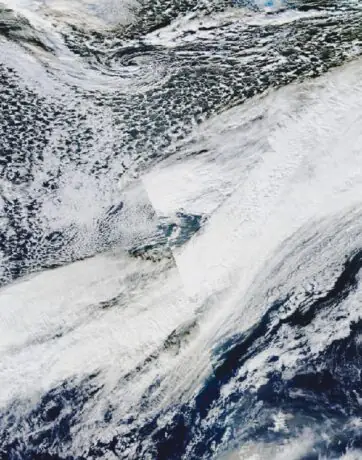
Featured image: GOES-19 satellite view of the August 27 MTG-I2 launch plume from French Guiana, produced by CSU/CIRA and NOAA and made available through Wikimedia Commons as U.S. NOAA public-domain material. The red point marks the launch area, and the line extending east is the visible plume. No editorial crop was applied before upload.
Method note: Smashology used Arianespace for the flight outcome, ESA for spacecraft capabilities, and EUMETSAT for operational timing. The report distinguishes deployment to transfer orbit from arrival and commissioning in final geostationary service.
Leon Ramoviq
Primary Author · Editorial Reviewer · Researcher Leon Ramoviq is a digital media researcher, content creator, and primary author at Smashology Media. His work focuses on researching, verifying, and developing stories across entertainment, culture, sports, internet trends, curiosity-driven topics, and viral news. Before publishing, Leon reviews sources, cross-checks key claims, and works to ensure that articles are clear, accurately represented, and based on reliable information rather than unverified social-media speculation. With experience in digital media, graphic design, social media content, and online audience engagement, he brings both an editorial and visual perspective to the stories published on Smashology. Leon is particularly interested in how stories spread online, why certain topics capture public attention, and how complex or trending information can be presented in a simple and engaging format. Role at Smashology As a primary author and researcher, Leon is involved in: • Researching stories and identifying original or reliable sources • Writing and developing articles for Smashology • Reviewing facts, names, dates, quotations, and contextual information • Checking stories for misleading or unsupported claims • Reviewing articles before publication • Following developments and updating stories when meaningful new information becomes available • Maintaining editorial consistency across Smashology content Editorial Approach Leon believes engaging content should not come at the expense of accuracy. His approach is to combine strong storytelling with responsible sourcing, clear attribution, and additional verification when a story originates from social media or rapidly developing online discussions.