The European Space Agency is tracking the final two spacecraft from its Cluster mission as they head toward carefully targeted atmospheric reentries over a remote part of the South Pacific.
Samba, also known as Cluster 3, is expected to reenter on August 31 at about 21:39:54 UTC, or 23:39:54 CEST. ESA narrowed the uncertainty to roughly one minute after receiving fresh orbital data and telescope observations on August 30. Tango, or Cluster 4, is expected to follow almost 24 hours later on September 1 at about 21:33:20 UTC, with the timing still subject to an uncertainty of around ten minutes in ESA’s latest published estimate.
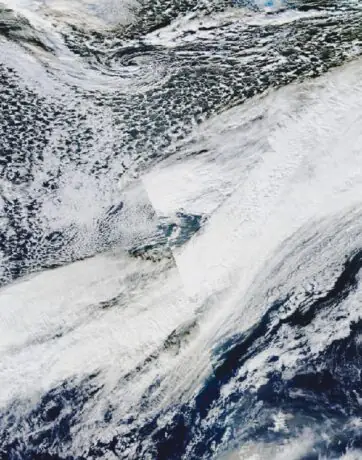
The predicted area is north of New Zealand and far from major population centers. ESA describes the operations as targeted reentries: mission controllers adjusted the satellites’ paths in advance so natural orbital decay would bring them down over a sparsely populated ocean region.
The spacecraft are not returning intact. They are expected to break apart and largely burn up as atmospheric drag and heat rapidly increase. ESA is treating the events as both responsible disposal operations and unusual scientific opportunities.
The end of a four-spacecraft mission
Cluster consisted of four nearly identical satellites named Rumba, Salsa, Samba and Tango. Launched in two pairs in July and August 2000, the quartet flew in changing formations around Earth to study how the solar wind interacts with the planet’s magnetic environment.
Earth’s magnetosphere acts as a shield against much of the stream of charged particles and magnetic fields flowing from the Sun. Measuring the region with four coordinated spacecraft allowed researchers to distinguish changes occurring over time from differences across space, a capability that a single satellite could not provide in the same way.
The mission formally ended on September 8, 2024, after more than two decades of operations. Salsa reentered in 2024. The remaining spacecraft were left on trajectories designed to bring them back in a controlled sequence, with Samba and Tango closing the disposal campaign.
ESA reported that Samba survived its final close pass above Earth, reaching an altitude of about 125 kilometers before moving outward once more on its highly elliptical orbit. The spacecraft powered back up after that encounter, allowing controllers to receive confirmation before the final descent.
A research aircraft will try to watch
The reentries are difficult to observe from the ground because they will happen over open ocean. To collect data, an international airborne campaign is flying from Tonga with optical and other instruments aimed at the predicted entry corridor.
ESA said controllers made final orbital adjustments in January 2026 partly so an aircraft could reach the area. The team plans two flights, separated by about a day, in an effort to observe Samba and Tango under comparable but not identical conditions.
Researchers want to record how spacecraft materials heat, fragment and emit light during reentry. Because Samba and Tango share the same design, their consecutive descents offer a rare opportunity to compare two closely matched objects under different atmospheric and orbital conditions.
The campaign also uses telescope observations and radiometric data to refine the satellites’ location. ESA said partners in the Inter-Agency Space Debris Coordination Committee have contributed tracking. The agency’s planetary-defense specialists are involved because the satellites’ long, stretched orbits can make them resemble small asteroids during optical observations.
Why reentry data matters
Uncontrolled reentries are hard to predict precisely. Small changes in atmospheric density, solar activity, spacecraft attitude and object shape can shift the time and location of breakup. Better observations can improve models that estimate where a spacecraft will fragment and which components may survive longer.
Those models are becoming more important as the number of satellites in orbit grows. Engineers can use reentry evidence when choosing materials, arranging components and designing spacecraft that are more likely to burn up completely at the end of service. ESA connects that work to its broader goal of reducing long-lived orbital debris and developing “zero-debris” mission practices.
Targeted disposal is not the same as a fully controlled reentry, in which an active spacecraft performs a final maneuver shortly before descent. Cluster’s satellites no longer have that level of control. Instead, earlier maneuvers set up their long-term trajectories so the eventual reentry corridor would cross a remote ocean area.
What to watch next
ESA is updating a live blog as tracking data changes. The exact time can still move, particularly for Tango, and confirmation may come only after the expected window when tracking networks no longer detect the spacecraft.
If weather and positioning allow the aircraft to capture the events, scientists will then need time to retrieve and analyze the recordings. The value of the campaign will not depend on dramatic video alone. Even partial measurements can help refine the physics and engineering of atmospheric breakup.
For Cluster, the two reentries mark the last operational chapter of a mission that transformed measurements of near-Earth space. For future missions, the data may help turn a carefully planned ending into a standard part of responsible spacecraft design.
Sources: ESA’s final Cluster reentries live blog, its reentry overview and the ESA Cluster mission page.
Leon Ramoviq
Primary Author · Editorial Reviewer · Researcher Leon Ramoviq is a digital media researcher, content creator, and primary author at Smashology Media. His work focuses on researching, verifying, and developing stories across entertainment, culture, sports, internet trends, curiosity-driven topics, and viral news. Before publishing, Leon reviews sources, cross-checks key claims, and works to ensure that articles are clear, accurately represented, and based on reliable information rather than unverified social-media speculation. With experience in digital media, graphic design, social media content, and online audience engagement, he brings both an editorial and visual perspective to the stories published on Smashology. Leon is particularly interested in how stories spread online, why certain topics capture public attention, and how complex or trending information can be presented in a simple and engaging format. Role at Smashology As a primary author and researcher, Leon is involved in: • Researching stories and identifying original or reliable sources • Writing and developing articles for Smashology • Reviewing facts, names, dates, quotations, and contextual information • Checking stories for misleading or unsupported claims • Reviewing articles before publication • Following developments and updating stories when meaningful new information becomes available • Maintaining editorial consistency across Smashology content Editorial Approach Leon believes engaging content should not come at the expense of accuracy. His approach is to combine strong storytelling with responsible sourcing, clear attribution, and additional verification when a story originates from social media or rapidly developing online discussions.