Video of two Philippine Air Force training planes colliding in mid-air over Fernando Air Base in Lipa City, Batangas, has spread quickly across social media. The crash killed all four pilots on board. A resident filmed the collision, which happened on Friday afternoon, October 23, 2026. The military has grounded its entire fleet of SF-260 trainers while it investigates.
The footage has been widely shared on Facebook, X and TikTok. It has also started an online debate about pilot safety, ageing equipment and how few aircraft the country’s military has.
What Happened Over Fernando Air Base
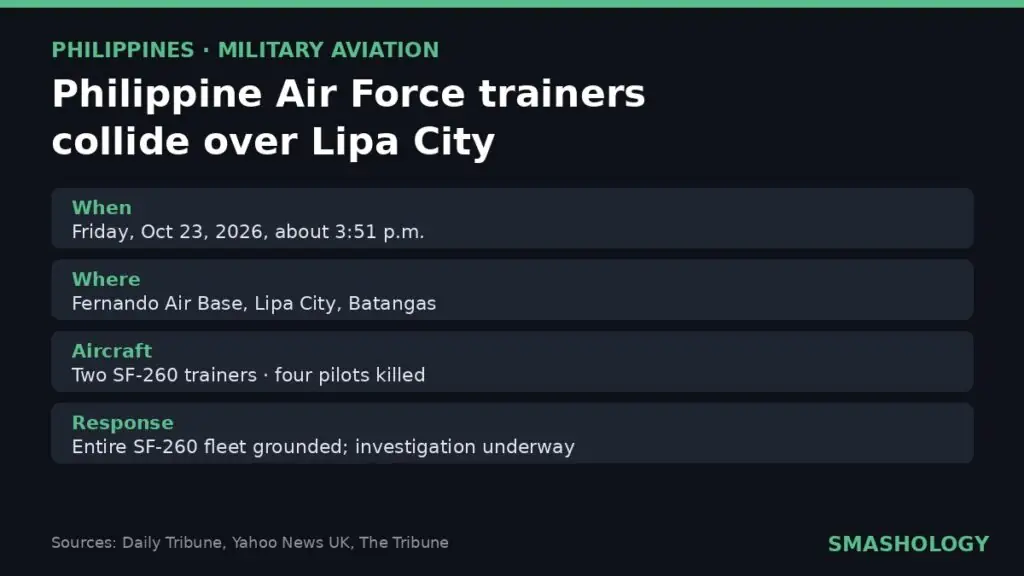
According to a Philippine Air Force statement released on Saturday, the collision happened at about 3:51 p.m. local time on October 23. Two SF-260 trainer aircraft collided during what the air force called a routine training flight. Both came down inside the perimeter of Fernando Air Base in Lipa City, in Batangas province south of Manila.
All four aviators on board were killed. No one on the ground was hurt. A witness told the Associated Press that one of the planes went down near the base’s military personnel barracks. Two Philippine officials, speaking anonymously, confirmed that the planes had collided in flight. The air force initially called the incident an “accidental crash” without giving details.
One of the victims has been identified as 1st Lt. Angeleo Adrian Peñaflor, from Iguig in Cagayan province. The air force has not publicly named the other three pilots and asked the public to respect the families’ privacy.
The Viral Video of the Philippine Air Force Crash
The clip that spread online was filmed by a resident near the base. It shows the two small trainers flying low before the collision, and it was widely shared within hours as people across the Philippines followed the news.
Reactions combined grief for the pilots with frustration about the state of the country’s air power. One widely shared comment read: “We have so few aircraft as it is — losing two in a training flight is a loss we can hardly afford.” Others questioned why the air force is still training new pilots on a design first flown decades ago.
Many users asked others to stop sharing the most graphic parts of the video out of respect for the families. That request now comes up regularly whenever a fatal accident is filmed. The air force has not commented on the footage itself.
Philippine Air Force Grounds Its SF-260 Fleet
As a precaution, the Philippine Air Force has temporarily grounded all of its remaining SF-260 trainers until the investigation is finished. It has not said how many of the aircraft are still in service.
Air force spokesperson Col. Alvin Jay Capinguian said response measures were activated immediately and that the priority was the safety and welfare of the personnel involved and of people near the crash site. “An investigation is underway to determine the cause of the accident,” he said. He added that the air force mourns the four pilots, honours their service and sacrifice, and is coordinating with their families.
Investigators will probably look at the formation and flight plan, communication between the two aircraft, visibility and weather, maintenance records and the pilots’ training levels. No cause has been announced.
What Is the SF-260?
The SF-260 is a light, propeller-driven military trainer. It was designed by Italian aircraft designer Stelio Frati and built by SIAI-Marchetti, which is why Filipinos often call it the “Marchetti.” It seats two and is used to teach student pilots the basics before they move on to more advanced aircraft.
The Philippine Air Force bought its SF-260s from Italy. They have also been used in combat. During the months-long battle to retake Marawi City from Islamic State-linked militants in 2017, the air force used them in a bombing campaign, which shows how stretched the country’s air assets were then.
A Pattern of SF-260 Accidents
The Lipa collision is not the first fatal SF-260 accident in recent years. In May 2026, an SF-260 crashed in a mountainous area of northern Luzon, killing two pilots. In 2023, another crashed during a training flight, also killing two.
That makes at least eight Philippine Air Force aviators killed in SF-260 accidents since 2023, half of them in this single collision. Each case is different and investigators have not linked them. Still, the number of incidents involving the same trainer type is likely to bring more scrutiny of the fleet’s age, maintenance and training procedures.
A Military Stretched Thin
The crash comes as the Philippine military is under pressure on several fronts. It has long struggled to modernise its air force, navy and army because of limited funding. At the same time it is dealing with decades-old communist and Muslim insurgencies and territorial disputes with China in the South China Sea.
Losing two aircraft and four trained aviators in one afternoon hurts in that situation. Every trainer lost reduces how many new pilots the air force can train, and every pilot killed represents years of training and experience. The online reaction shows that many Filipinos understand this.
Why the Philippine Air Force Video Spread So Fast
The video spread fast for the same reasons other footage of fatal aviation accidents does. It was filmed by an ordinary resident rather than released by officials. It showed the event from the ground. And it came out before the military had shared details. With little official information in the first hours, the clip became the main way people understood what had happened.
Moments like this also bring out national feeling. Public anger in the comments wasn’t aimed at the pilots. It was aimed at long-standing questions about military funding and equipment, and the video gave those concerns an image.
How Military Training Collisions Are Investigated
Military investigations into mid-air collisions usually follow a standard process. Investigators reconstruct each aircraft’s flight path from radar data, flight records and witness accounts. They review radio transcripts between the pilots and air traffic control. They examine the wreckage for mechanical failures, and they check the pilots’ training records, rest periods and recent flying experience.
In formation or close-proximity training, investigators pay particular attention to how separation between the aircraft was supposed to be maintained, and what happened when it wasn’t. Weather, sun glare and visibility at the time are also considered. Video like the clip that went viral can help reconstruct the final seconds, although investigators usually rely on official data for their conclusions.
The Philippine Air Force has not said how long its investigation will take or whether the results will be made public in full. Previous SF-260 investigations have been handled internally, with summary findings released later.
The Debate Over the Philippine Air Force’s Ageing Trainers
The crash has renewed a debate in the Philippines about whether the air force should replace its SF-260s with newer training aircraft. Supporters of the current fleet say the SF-260 is a proven, forgiving aircraft that is well suited to basic flight training and inexpensive to operate. Critics say the airframes are old, spare parts are harder to find, and modern trainers offer better safety systems and more realistic preparation for advanced aircraft.
Replacing a training fleet takes years and requires large budgets, which the Philippine military has struggled to secure. For now, the grounding means the air force must decide how to keep pilot training going while the investigation continues. Options could include shifting students to other aircraft or simulators, or pausing some parts of the training programme.
For the many Filipinos who shared the video, the hope is that the four pilots’ deaths lead to real improvements in safety rather than just another report.
Remembering the Four Philippine Air Force Pilots
Behind the viral clip are four young aviators who were still training. Pilots who fly the SF-260 are usually early in their careers, learning the skills they will later use in more advanced aircraft. Messages of condolence for the Philippine Air Force pilots have filled the comments under the video, from fellow servicemembers, former instructors and people who never knew them. In Iguig, Cagayan, the hometown of 1st Lt. Angeleo Adrian Peñaflor, residents have shared tributes online.
What Comes Next
The Philippine Air Force investigation is expected to take time. Findings in military aviation accidents are often released weeks or months later. Until then, the SF-260 fleet stays grounded, which will disrupt pilot training schedules.
The families of the four aviators are expected to receive full military honours. More names may be released once the families agree. For a country that depends heavily on a small air force, the outcome of the investigation, and whether it leads to changes in training practice or equipment, will be closely watched. For more stories like this, follow Smashology’s Viral section.
Frequently Asked Questions
When did the Philippine Air Force collision happen?
At about 3:51 p.m. on Friday, October 23, 2026, over Fernando Air Base in Lipa City, Batangas.
How many people died?
Four pilots were killed. No one on the ground was hurt.
What aircraft were involved?
Two SF-260 trainers, light two-seat planes built by Italy’s SIAI-Marchetti.
Has the fleet been grounded?
Yes. The Philippine Air Force has temporarily grounded all its SF-260s pending the investigation.
Sources
Daily Tribune: Four aviators killed in mid-air collision involving PAF training aircraft
Yahoo News UK: Four Philippine pilots killed after two training planes collide mid-air
The Tribune: Viral video captures mid-air collision of 2 air force planes that killed 4 pilots in Philippines
Militarnyi: Two SF-260 military aircraft collided in Philippines
Leon Ramoviq
Primary Author · Editorial Reviewer · Researcher Leon Ramoviq is a digital media researcher, content creator, and primary author at Smashology Media. His work focuses on researching, verifying, and developing stories across entertainment, culture, sports, internet trends, curiosity-driven topics, and viral news. Before publishing, Leon reviews sources, cross-checks key claims, and works to ensure that articles are clear, accurately represented, and based on reliable information rather than unverified social-media speculation. With experience in digital media, graphic design, social media content, and online audience engagement, he brings both an editorial and visual perspective to the stories published on Smashology. Leon is particularly interested in how stories spread online, why certain topics capture public attention, and how complex or trending information can be presented in a simple and engaging format. Role at Smashology As a primary author and researcher, Leon is involved in: • Researching stories and identifying original or reliable sources • Writing and developing articles for Smashology • Reviewing facts, names, dates, quotations, and contextual information • Checking stories for misleading or unsupported claims • Reviewing articles before publication • Following developments and updating stories when meaningful new information becomes available • Maintaining editorial consistency across Smashology content Editorial Approach Leon believes engaging content should not come at the expense of accuracy. His approach is to combine strong storytelling with responsible sourcing, clear attribution, and additional verification when a story originates from social media or rapidly developing online discussions.