The Orionid meteor shower reaches its expected peak around October 21–22, offering a chance to see debris left by Halley’s Comet. A bright Moon will complicate viewing in 2026, so clear skies, patience and realistic expectations matter more than dramatic hourly-rate headlines.
The peak is a window, not a guaranteed spectacle
The Orionids are reaching their expected maximum around the night of October 21 into October 22. NASA’s shower guide lists that peak within an active period running from October 2 to November 7. This is an annual encounter with comet debris, rather than the return of Halley’s Comet itself. The distinction matters when striking sky photographs circulate beside headlines announcing the shower.
The Royal Observatory Greenwich’s 2026 guide describes a broad maximum, with opportunities on several nights around the nominal peak. It also identifies a waxing gibbous Moon on October 21 as a source of interference. The published date is therefore a useful planning guide, not an appointment at which the sky must suddenly fill with visible streaks.
For readers in Europe/Belgrade, the relevant overnight period crosses from Wednesday into Thursday. Someone reading this on Thursday morning should not assume the annual event has disappeared because a headline said “tonight” on Wednesday. The stream remains active beyond the peak, although the number visible from any particular location depends on conditions.
Why the shower is associated with Halley
NASA’s account of comet 1P/Halley places its most recent passage in 1986 and its next return in 2061. Its orbit takes roughly 76 years. The Orionids provide a much more frequent connection with the material it has shed, without requiring the parent comet to be nearby on the night of observation.
The difference is between the comet and the debris distributed along its path. A comet can move far away while material it left behind remains available for Earth to encounter. Seeing the resulting meteor is not the same as seeing the distant comet’s nucleus. A headline suggesting that Halley itself is making an October 2026 close appearance would confuse those two events.
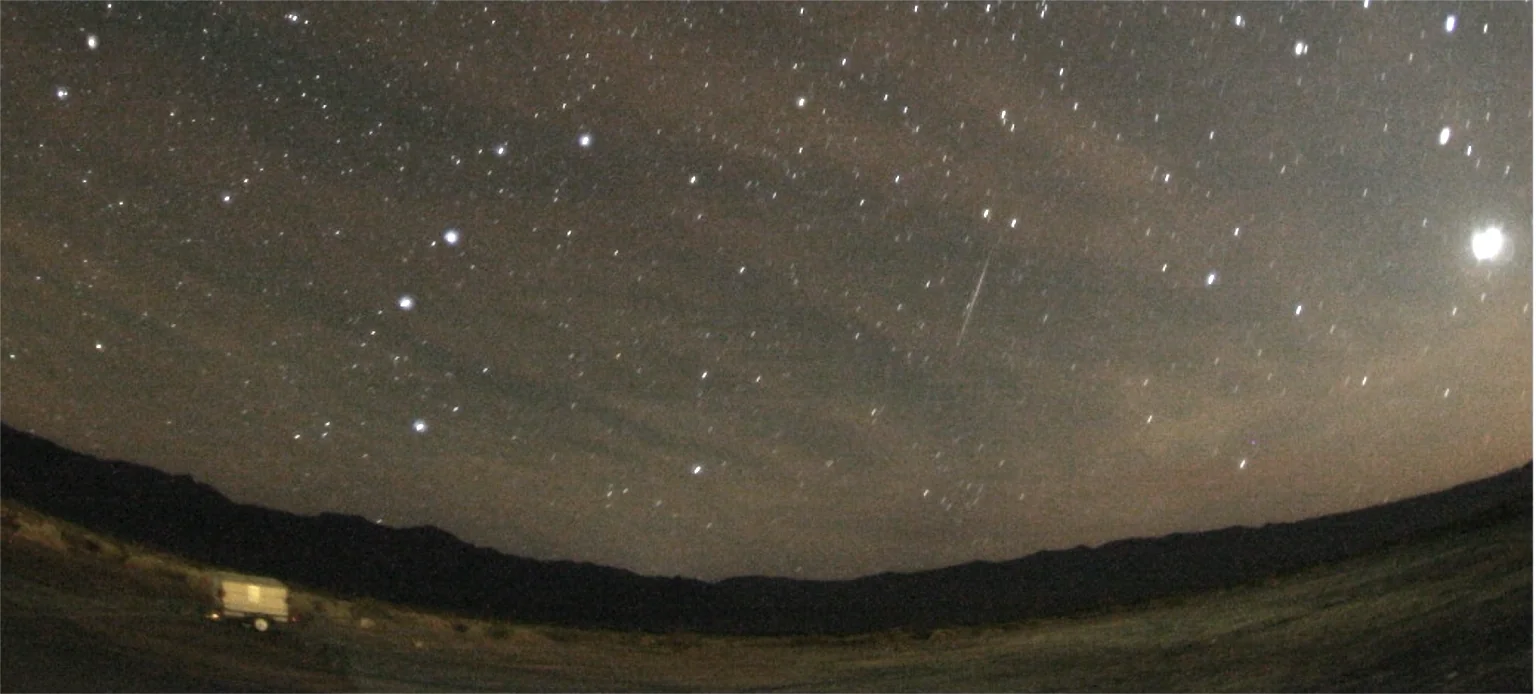
That is also why an archive picture can legitimately illustrate what an Orionid looks like while failing to document the current shower. An archive photograph can provide historical visual context when its date is retained. It cannot establish the brightness, weather, meteor rate or appearance of the sky over any city in October 2026.
What produces the brief streak of light
NASA describes the Orionids as fast meteors, travelling at about 66 kilometres per second. Some can leave visible trains after the initial flash, and occasional bright meteors can be particularly striking. Those possibilities help explain the appeal of watching a seemingly quiet patch of sky for an unpredictable, short-lived event.
Greenwich explains that the luminous streak is produced when cometary debris enters the atmosphere. Its guide notes that even very small particles can create a visible meteor. The spectacle does not require a large object to travel intact to the ground. In everyday conversation “shooting star” is familiar shorthand, but the event is not a star falling out of the constellation.
That distinction is worth retaining when describing a sighting to someone else. What an observer sees is a brief luminous track, not a close view of the original particle or proof of its composition. A photograph may preserve the track, but identifying an individual meteor with a particular shower requires more context than simply noticing a bright line in the sky.
The hourly number is not a personal promise
The American Meteor Society’s shower table explains the convention behind zenithal hourly rates. The reference conditions include a radiant overhead and a dark sky with a specified limiting magnitude. Such a standardised figure is useful for comparing activity, but it should not be read as the number everyone will see from their own garden.
Local obstructions, light pollution, clouds and the position of the shower’s radiant all affect the view. Two people observing the same stream can report different experiences without either being mistaken. One may have a broad dark horizon and a long uninterrupted session; the other may be looking between buildings through thin cloud for only a few minutes.
There is also a difference between an average rate and a regular interval. A rate does not mean that a meteor appears every fixed number of seconds. A quiet stretch can be followed by several sightings close together. Planning a session around a guaranteed countdown would create expectations the forecast does not support.
Moonlight makes this year less straightforward
The Associated Press’s October 20 preview highlights the bright Moon as a complication and notes the advantage of observing after it sets. That is a general observing consideration, not a single moonset time that applies worldwide. The time changes with location and date.
To plan locally, use a location-aware astronomy service such as timeanddate’s Orionid guide, along with a current weather forecast. A global shower prediction cannot tell you whether your particular neighbourhood will be cloud-free. This article does not claim a verified cloud forecast or a precise moonset time for every reader.
The practical choice is often between a convenient but brighter session and a later one with potentially better conditions. Neither guarantees a sighting. If only a short window is available, treating it as an opportunity to observe the night sky is more realistic than expecting a sequence resembling a carefully edited video compilation.
How to organise a useful observing session
NASA recommends viewing after midnight, allowing about 30 minutes for dark adaptation and looking across a broad area of sky. The radiant lies near Orion, but meteors can appear away from that point. A telescope aimed at a tiny area is not the basic tool needed for this wide-field activity.
A workable plan begins before leaving home: choose a location you can use legitimately, check access and decide how to return. A dark site is useful only if the journey and the observing position are suitable. For a casual session, a familiar open area with a clear view may be more practical than an unfamiliar remote location selected solely for its darkness.
Arrange a seat or reclining position that avoids continually straining your neck. Keep essentials within reach and avoid repeatedly interrupting the session to search a bright phone screen. These are practical suggestions for maintaining a comfortable period of observation, not special equipment requirements or a promise that a longer session will produce a particular count.
If observing with friends, decide whether you are simply enjoying the display or trying to keep a count. A casual group total can double-count one meteor seen by several people. A useful personal record can instead note the start and finish time, interruptions and the parts of the sky that were obstructed.
What photographs can and cannot establish
A published night-sky photograph is a record made through a camera, with choices about exposure and presentation. It should not automatically be treated as an exact reproduction of what an unaided observer saw at one instant. Before sharing an impressive image as evidence of the 2026 Orionids, check its date, location, photographer and description.
The same care applies to compilations and illustrations. A montage can be useful when its construction is disclosed, but it cannot demonstrate that all the pictured meteors appeared together. An old image with a new caption may show a real meteor while making a false claim about when it was photographed. Authenticity and current relevance are separate questions.
Our recent report on a real video shared with a wrong date and location illustrates that broader verification problem. For skywatching, the remedy is straightforward: retain the original caption and source, and distinguish an archive illustration from a documented observation of this year’s event.
The history gives the shower a larger context
The comet connection extends beyond an annual viewing opportunity. ESA’s overview of Giotto describes the spacecraft’s historic encounter with Halley in March 1986. That mission investigated the comet directly, a fundamentally different kind of observation from watching small debris produce meteors in Earth’s atmosphere.
The comparison helps explain why the Orionids remain interesting even in a year affected by moonlight. A modest streak connects an ordinary night outside with a much larger orbital history and with the scientific effort to understand comets. The event does not need an invented record rate or an exaggerated claim about a returning comet to be worth watching.
The evidence supports a measured invitation: the expected peak is here, the shower remains active around it, and the viewing conditions will vary. Check the sky and local circumstances, give your eyes time, and treat any sighting as an observation rather than a guarantee fulfilled. For anyone unable to see a meteor, properly credited images and reliable observing reports offer context without pretending to replace a live view.
If you do see a promising meteor, a simple note made immediately afterwards can preserve more useful context than a confident caption written hours later. Record the approximate time and direction, whether a trail remained and whether clouds affected the view. Avoid supplying a precise brightness or classification you cannot support. An honest description of a brief observation is more valuable than turning an uncertain glimpse into a claim of an exceptional event.
The same approach works when comparing reports from friends in other places: first compare observing conditions and session length. A difference in personal counts does not automatically mean that the stream changed dramatically between the two locations.
Smashology Editorial Team
The Smashology Editorial Team is responsible for reviewing and publishing content at Smashology Media, overseeing sourcing, fact-checking, corrections, and editorial standards across coverage of internet culture, technology, entertainment, news, and crime.
Sources
Links cited in this article.
- Sourcecommons.wikimedia.org
- Licencecreativecommons.org
- NASA’s shower guidescience.nasa.gov
- Royal Observatory Greenwich’s 2026 guidermg.co.uk
- NASA’s account of comet 1P/Halleyscience.nasa.gov
- American Meteor Society’s shower tablestatic.amsmeteors.org
- Associated Press’s October 20 previewapnews.com
- timeanddate’s Orionid guidetimeanddate.com
- ESA’s overview of Giottoesa.int