Spain’s DANA Adam emergency has entered a new phase after extensive rescues in Valencia and Alicante. Local restrictions were lifted on Monday evening, but further rain warnings for Tuesday underline how recovery and continuing weather risks can overlap.
Emergency services carried out more than a thousand rescues across the Valencian Community during the DANA Adam episode, regional public broadcaster À Punt reported in its Monday evening update. The report also recorded three storm-related deaths in that region. These are regional figures, rather than a complete national accounting of the weather emergency.
The developments on October 19 mark a transition from the most intense downpours toward rescue, clearance and assessment. They do not establish that every affected place is safe or that the episode has finished. Conditions have changed at different speeds across Spain’s Mediterranean coast and islands, making the location and time attached to each update particularly important.
Restrictions eased after a day of rescues
À Punt’s update, timestamped 22:28 local time, said restrictions had been lifted that afternoon in the eight municipalities that remained subject to confinement measures earlier in the day. It also reported the demobilisation of Military Emergencies Unit personnel working in La Safor and Marina Alta. Those decisions describe the status of particular response measures; they should not be read as an unrestricted invitation to travel through damaged neighbourhoods.
The same account put the number of incidents handled by the 112 service at 1,713: 1,202 in Valencia province, 492 in Alicante and 19 in Castellón. An incident count and a rescue count measure different things. A single incident can involve several people, while calls can also concern flooded infrastructure or other problems. Adding the two totals together would misrepresent the scale of the response.
Earlier, Europa Press reported hundreds of helicopter rescues, citing the participation of several administrations and emergency services. Its report described temporary mobility restrictions affecting 145 municipalities at an earlier stage. That earlier geographical scope and the smaller group still restricted later in the day belong to a changing timeline, rather than contradictory orders issued simultaneously.
Deaths require careful regional accounting
Europa Press said Defence Ministry sources confirmed that UME personnel had found the body of an elderly woman in Oliva during rescue work. The later regional account also included a 64-year-old man who suffered a heart attack at a campsite in that municipality and a woman who died after entering the sea on Sunday. Their circumstances should not be collapsed into a single description of people swept away by river flooding.
A wider El País account reported four storm-related deaths nationally, including a woman in Catalonia. The difference from the Valencian total reflects geographical coverage. As authorities establish circumstances and update their records, attribution remains essential: these are reported storm-related fatalities, not a claim that every death had the same immediate cause.
Tuesday’s forecast remains part of the story
Monday’s recovery work took place with further instability still forecast. An 18:21 Europa Press forecast carried by elDiario.es said nine provinces would remain under warnings on Tuesday, October 20, with orange rain warnings expected in Barcelona and Girona. It also listed rain or storm alerts for parts of the Balearic Islands, the southeast and other areas.
The forecast described the possibility of locally very heavy showers and significant accumulations in Catalonia and the Balearics. It expected precipitation to ease from south to north during Tuesday, while a separate approaching front would increase cloud in the northwest. That is a forecast evolution, not a guarantee that every locality will follow the same timetable.
The practical distinction is between a regional trend and a street-level decision. A broad improvement can coexist with a remaining warning, an impassable underpass or a watercourse that has not yet subsided. People deciding whether to travel need the current local notice and route status, rather than a screenshot of a national map saved hours earlier.
Why the morning’s alert map cannot describe the evening
At 13:51 on Monday, Europa Press relayed AEMET’s warning against lowering vigilance before Tuesday, especially in already flooded parts of La Safor and La Marina. The agency said the most critical phase of torrential rain had passed, but more scattered storms could still be strong.
That statement helps explain why a downgrade is significant without being an all-clear. A warning describes anticipated weather in a defined area and period; it does not certify the structural condition of a bridge or the safety of an individual building. Emergency restrictions and meteorological warnings therefore need to be read together, while recognising that they answer different questions.
It also explains why early reporting needs visible dates. A red warning issued for Monday morning remains part of the chronology even after it expires. Reposting it without its validity window can leave readers with an inaccurate picture. The useful update is the change itself: where the risk has diminished, where it persists and what authorities currently require.
The atmospheric setup was identified before the worst rain
Spain’s Interior Ministry issued a Civil Protection notice on October 16 identifying Sunday and Monday as the likely most adverse days. It described an isolated upper-level low over the northern peninsula and moist easterly or northeasterly flows encouraged by high pressure near the British Isles. Together, those features favoured persistent precipitation around the Mediterranean.
The notice specifically warned of local flooding in low-lying areas and sudden rises in streams and normally dry channels, particularly where earlier rain had saturated the ground. It also acknowledged uncertainty over the precise location of the low, surface winds and resulting rainfall distribution. Such uncertainty concerns where the greatest impacts will occur; it does not make the underlying flood risk hypothetical.
What DANA means, and what it does not establish
In its meteorological explainer, AEMET describes a DANA as a closed circulation at upper levels separated from the jet stream. The name identifies an atmospheric structure. It is more precise than using “cold drop” as a general label for any severe rain event.
Cold air aloft can help rising air continue upward, encouraging tall storm clouds when the necessary moisture and instability are present. The actual consequences also depend on the rain’s persistence and location. A named system is therefore not a fixed quantity of rainfall delivered uniformly across a region.
AEMET’s explanation also discusses ways climate change can influence moisture and larger atmospheric patterns. That general mechanism does not provide an event-specific percentage for Adam. Establishing how much warming altered this particular episode would require a dedicated attribution analysis. No such numerical finding is asserted here, and the exceptional severity of a local observation should not be treated as a substitute for that work.
The Balearic response shows the emergency’s wider reach
The response extended beyond the mainland. El Confidencial Digital reported the UME’s deployment toward Ibiza and Mallorca, reproducing October 18 communications from the unit. Personnel from its Third Emergency Intervention Battalion travelled from Valencia to reinforce the island response.
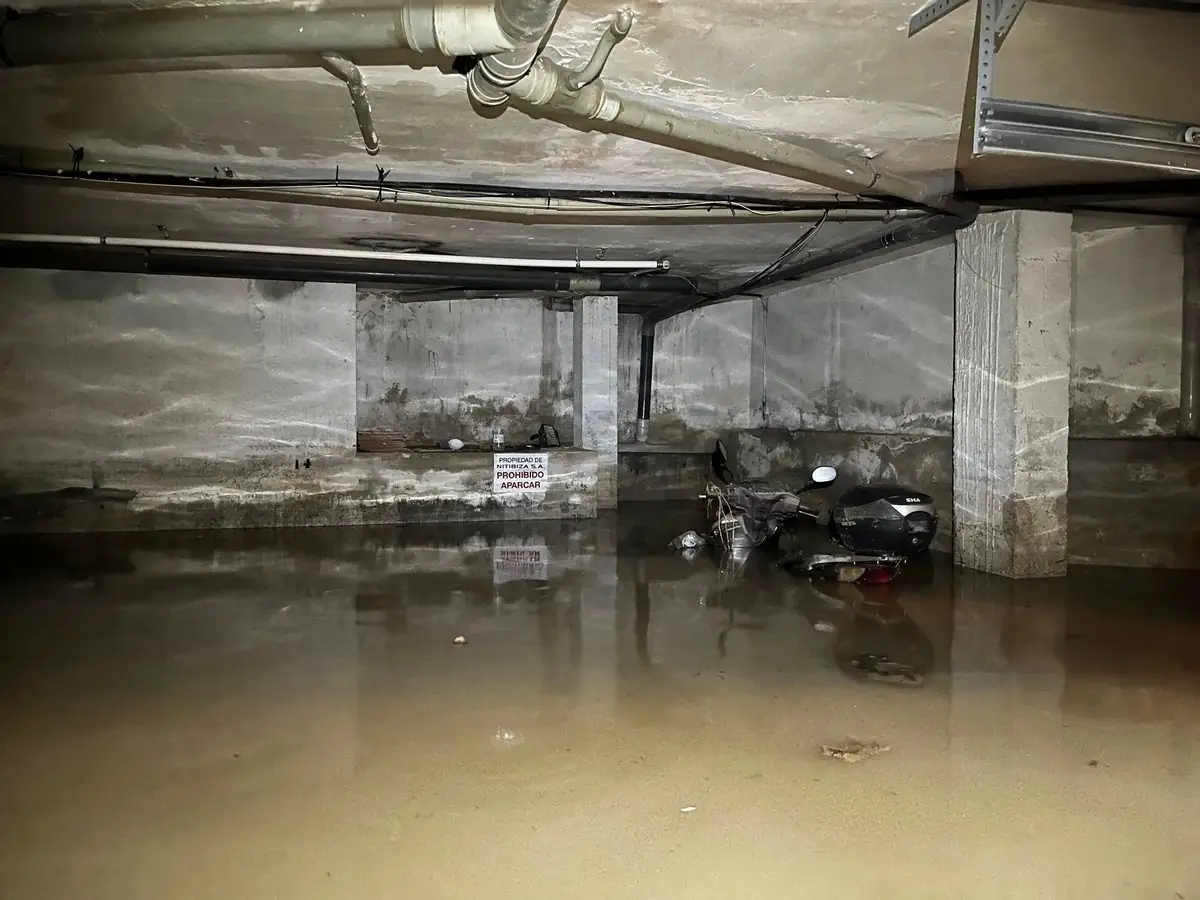
The report described flooded roads and disruption around Ibiza’s airport access, alongside pumping work in garages. Separately, Servimedia reported an October daily rainfall record at Ibiza airport in a series beginning in 1944. That is a record for a specific station and month; it does not establish an all-Spain rainfall record or the same accumulation across the whole island.
Rainfall totals need their measurement windows
An El País mapping report listed AEMET observations of approximately 465 millimetres in 24 hours at Pego, nearly 410 at Oliva and 371 at Miramar. Other figures circulating during the episode refer to different stations or longer accumulation periods. They should not be treated as interchangeable measurements of the same place and interval.
A millimetre of rain corresponds to one litre over a square metre. Even that straightforward conversion leaves crucial questions unanswered: how quickly the rain fell, where runoff travelled, and whether drainage could accommodate it. A large daily total describes accumulated water; it does not describe every short burst within the day or the eventual flood depth at a nearby home.
For meaningful comparisons, a station name, observation period and reporting time belong beside the number. Comparing one town’s six-hour burst with another’s two-day total can produce a dramatic headline without a useful conclusion. Likewise, a preliminary network observation and a subsequently checked official record can serve different purposes. The immediate emergency report should preserve those distinctions rather than force all available measurements into a single ranking of storms.
Recovery will be measured beyond the rain gauge
In an evening Cadena SER interview, government delegate Pilar Bernabé emphasised anticipation and coordination in the response. Her assessment is an official’s account of operations, rather than an independent audit. A fuller evaluation will need to consider how warnings reached residents, how quickly assistance arrived and which services remained accessible.
The immediate priorities and the eventual review are connected. A rescue total records urgent interventions, but it cannot by itself show how many households face extended displacement or how long damaged infrastructure will take to restore. Those questions need subsequent local assessments. Treating an early response figure as a complete measure of loss would obscure the work that follows.
For readers following dramatic clips online, chronology matters as much as location. A video showing the peak of a flood can remain authentic after conditions improve, while still being misleading if presented as a live view. Smashology’s earlier coverage of another rapidly changing emergency likewise distinguishes the original incident from later response decisions. Adam’s next meaningful updates will concern remaining warnings, safe access, confirmed damage and the needs of people beginning to recover.
Smashology Editorial Team
The Smashology Editorial Team is responsible for reviewing and publishing content at Smashology Media, overseeing sourcing, fact-checking, corrections, and editorial standards across coverage of internet culture, technology, entertainment, news, and crime.
Sources
Links cited in this article.
- UME / Spanish Ministry of Defencex.com
- published reuse termsume.defensa.gob.es
- À Punt reported in its Monday evening updateapuntmedia.es
- Europa Press reported hundreds of helicopter rescueseuropapress.es
- El País account reported four storm-related deaths nationallyelpais.com
- 18:21 Europa Press forecast carried by elDiario.eseldiario.es
- Europa Press relayed AEMET’s warning against lowering vigilance before Tuesdayeuropapress.es
- Civil Protection notice on October 16interior.gob.es
- meteorological explaineraemetblog.es
- El Confidencial Digital reported the UME’s deployment toward Ibiza and Mallorcaelconfidencialdigital.com
- Servimedia reported an October daily rainfall record at Ibiza airportservimedia.es
- El País mapping reportelpais.com
- Cadena SER interviewcadenaser.com