Andorra, San Marino and the European Union signed an association agreement in Brussels on October 19, opening the next stage of a long integration process. The deal promises closer single-market ties, but parliamentary consent, domestic ratification and conditions on financial services remain essential before its benefits can apply.
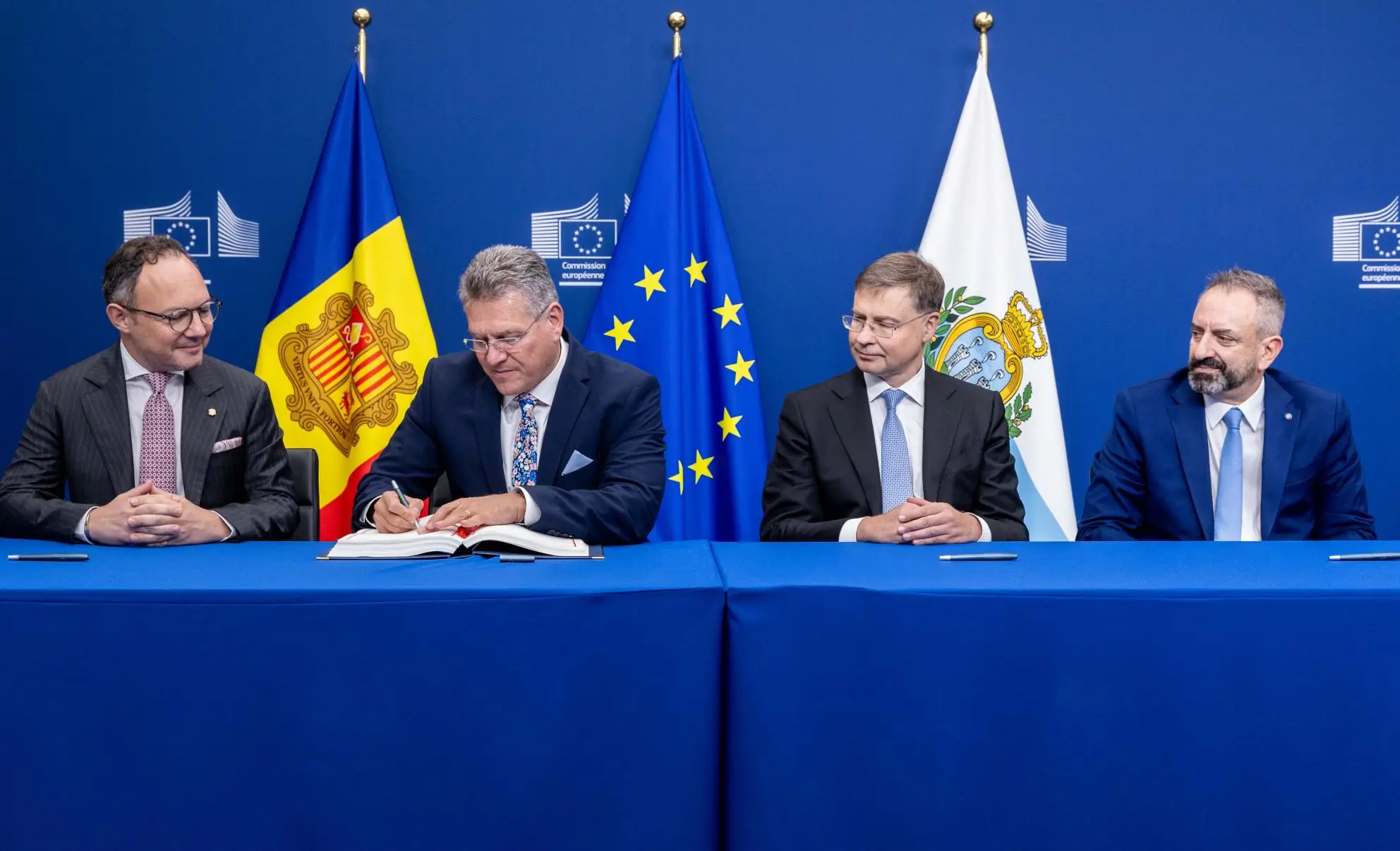
Andorra and San Marino have reached a significant milestone in their relationship with the European Union. The association agreement signed in Brussels on Monday, October 19, provides a framework for much deeper participation in the EU’s internal market. On October 20, the important question is what that signature changes—and which decisions still lie ahead.
The European Commission’s official announcement confirms the signing and describes common rules and fair competition as the basis of the new relationship. It also identifies cooperation in research, education, social policy, the environment and consumer protection. The development is broader than a tariff announcement, while remaining distinct from either country joining the EU as a member state. The Commission’s October 19 release sets out the agreement’s purpose.
A signature is a milestone, not the whole legal process
The distinction matters because different institutions carry out different stages of an international agreement. Authorising a signature, signing a negotiated text, obtaining parliamentary consent and completing ratification are not interchangeable acts. A photograph of the ceremony records a completed political and diplomatic step; it does not demonstrate that every provision already applies to every resident or business.
Andorra’s government was explicit about this before the ceremony. Its October 14 announcement said that signature would close the negotiation stage and open ratification, without itself bringing the agreement into force or making it applicable in Andorra. It described European Parliament consent, a referendum and a subsequent vote in the Consell General as the intended domestic sequence. The government’s pre-signing explanation provides that procedural context.
For readers following the story from outside the two countries, the safest way to interpret the news is therefore to separate the negotiated destination from the steps needed to reach it. The agreement sets out a relationship the parties intend to implement. Whether a particular right or obligation applies on a particular date must be checked against the relevant approval and implementation provisions.
Who signed, and what the ceremony confirmed
EFE’s account of the Brussels ceremony identifies Andorran head of government Xavier Espot and San Marino’s foreign affairs secretary Luca Beccari alongside European commissioners Maroš Šefčovič and Valdis Dombrovskis. Its reporting corroborates the signing and describes the agreement as a route into the single market under shared rules. It also reports the parties’ emphasis on study, work and business opportunities. EFE’s report from Brussels provides an independent contemporary account.
The practical importance of the ceremony is that the parties have moved from negotiation to formal approval work on an agreed text. That reduces one kind of uncertainty: whether negotiators can arrive at a common document. It leaves another kind: whether the necessary political institutions and electorates will support implementation, and how the agreed obligations will operate in practice.
Those uncertainties should not be described as evidence that the signature has no value. Equally, positive statements at a signing ceremony should not be treated as a substitute for the remaining decisions. Both points can be true at once: the agreement represents substantial diplomatic work, and important approval stages are still required.
Market access comes with a common-rule framework
The Council of the EU authorised signature and provisional application in July. Its explanation describes participation in a homogeneous extended internal market with equal conditions of competition and respect for common rules. It also says the agreement takes account of the partners’ geography, small populations and close relationships with neighbouring member states. The Council’s July decision announcement explains that balance.
A shared market is more than permission to sell across a border. Rules on competition, consumer rights, services and other activities help determine whether participants face comparable conditions. That is why legal alignment appears repeatedly in the official explanations. Removing differences in treatment can require changes to the rules under which domestic firms already operate, rather than only opening opportunities elsewhere.
Andorra’s official information portal describes incorporating the EU legislation needed for participation in the internal market, including rules connected with the movement of people, goods, services and capital. It also identifies competition, social rights, consumer protection, the environment, transport and statistics as part of the wider framework. The government’s explanation of the agreement shows why the implementation task extends across several areas of public administration.
For a small state, that combination creates both an opportunity and a workload. More predictable access can matter to an enterprise considering cross-border activity. Adopting and administering the relevant rules can also require expertise and institutional capacity. The meaningful test will be how those commitments are implemented, rather than whether the agreement is described only as an opening or only as a burden.
Financial services are subject to additional conditions
The Council makes a specific distinction for financial services. Access is intended to be progressive and depends on a successful assessment of the strength of the countries’ regulatory and supervisory frameworks, with European supervisory authorities involved in evaluation and monitoring. That conditional structure should remain attached to any headline about financial-market access.
It would be premature to turn the signature into a claim that every bank or financial business can immediately operate everywhere in the EU on unchanged terms. The agreement’s conditions, the relevant implementation timetable and the particular activity all matter. This article reports the institutional framework; it does not establish that a named institution has obtained an authorisation.
The broader implication is that market integration can depend on the credibility of supervision as well as the willingness to trade. Shared access creates a need for confidence in how rules are applied. The planned assessment is therefore part of the access mechanism itself, rather than an unrelated administrative detail that can be omitted from an account of the deal.
The euro arrangements are a separate, connected layer
The Commission also announced updated monetary agreements with both countries to address overlaps with the association framework. Andorra and San Marino already have separate arrangements governing their use of the euro and related obligations. Updating those arrangements alongside association is intended to maintain legal consistency rather than introduce the euro for the first time.
This distinction prevents another possible misunderstanding. Using the euro, participating in parts of the internal market and being an EU member are different legal relationships. One does not automatically imply all the others. A country can have a monetary agreement with the EU while remaining outside its membership and negotiating other forms of cooperation.
For the public, the importance is clarity about which agreement governs which obligation. When older and newer arrangements cover related subjects, an update can help prevent duplicated or inconsistent duties. That is a legal-coordination task, not a statement that the wider integration process has already finished.
Andorra’s referendum will be a separate political test
Radio SER Andorra reported after the signing that Espot again said the referendum would not be called before the next general election. Its report places the ceremony at the beginning of the ratification stage and distinguishes that stage from the public vote. No specific referendum date should be inferred from the signature alone. SER’s account of the post-signing remarks records that timetable distinction.
The government’s published sequence says a favourable referendum would be followed by ratification in the Consell General, requiring a two-thirds majority. It also says the agreement cannot apply in Andorra without that ratification. The referendum and the parliamentary decision therefore have separate roles; describing either one as already completed would be inaccurate.
The official Andorra–EU information site also explicitly distinguishes association from accession: Andorra has negotiated association and is not seeking to become a new EU member through this agreement. The government’s information portal is a useful reference for that difference. A debate over the merits of association should address the agreement on offer, rather than substitute a different proposition about EU membership.
The full agreement’s title describes Andorra and San Marino as separate parties. That wording matters when following the next decisions: the two countries do not share a single domestic electorate or one parliamentary approval process. Reporting on a step taken in Andorra should not automatically be applied to San Marino, or vice versa. The Council’s document register identifies the agreement and its published texts for readers checking that structure.
How the negotiations reached this point
The Commission dates the negotiating mandate to December 2014 and the opening of negotiations to 2015. Talks initially involved Monaco as well, but negotiations with Monaco were suspended in September 2023. Negotiations continued with Andorra and San Marino and concluded in December 2023. The Council’s July 2026 authorisation and October’s signature followed that earlier negotiating work.
This chronology explains why a brief ceremony can represent a much longer process. It also helps readers identify older material circulating alongside current coverage. A document describing negotiations as ongoing may have been accurate when published but does not by itself describe the position after the October 19 signature. Conversely, the latest ceremony does not make older explanatory documents irrelevant; their provisions and status still need to be checked.
The next verifiable developments will be parliamentary consent, the partners’ respective ratification steps and any confirmed start of provisional application. None should be announced before it happens. For now, the agreement is signed and the approval process has moved to its next stage. Our News section follows those institutional decisions with source links and clear distinctions between proposals, approvals and measures that have actually taken effect.
Smashology Editorial Team
The Smashology Editorial Team is responsible for reviewing and publishing content at Smashology Media, overseeing sourcing, fact-checking, corrections, and editorial standards across coverage of internet culture, technology, entertainment, news, and crime.
Sources
Links cited in this article.
- Official sourcebarcelona.spain.representation.ec.europa.eu
- CC BY 4.0creativecommons.org
- reuse policycommission.europa.eu
- The Commission’s October 19 releaseec.europa.eu
- The government’s pre-signing explanationareb.ad
- EFE’s report from Brusselsefe.com
- The Council’s July decision announcementconsilium.europa.eu
- The government’s explanation of the agreementandorraue.ad
- SER’s account of the post-signing remarkscadenaser.com
- The government’s information portalandorraue.ad
- The Council’s document registerconsilium.europa.eu