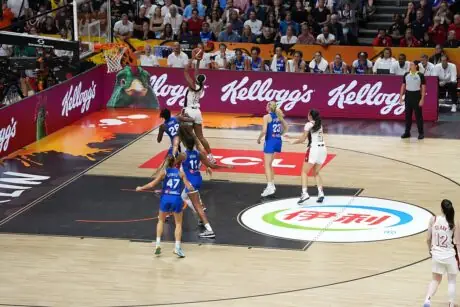
The United States defeated France 97–79 in Berlin on September 13, 2026, securing its fifth consecutive women’s basketball World Cup title. The interesting question in the scorebook is how a two-point halftime deficit became an 18-point win.
Smashology calculated the cumulative scores and margins below from FIBA’s official game record. This is a score analysis, not an account based on attendance or player interviews.
Reconstructing the lead, one quarter at a time
| Period | USA points | France points | Running score, USA–France | USA margin |
|---|---|---|---|---|
| First | 17 | 20 | 17–20 | −3 |
| Second | 26 | 25 | 43–45 | −2 |
| Third | 30 | 12 | 73–57 | +16 |
| Fourth | 24 | 22 | 97–79 | +18 |
The method is straightforward: add each team’s quarter points to its previous total, then subtract France’s cumulative score from the USA’s. A negative margin means France was ahead; a positive margin means the USA led. The two first-half periods together produced 43 American points and 45 French points. The final totals also reconcile: 17 + 26 + 30 + 24 = 97, and 20 + 25 + 12 + 22 = 79.
Why the third quarter is the numerical turning point
The USA outscored France by 18 in the third quarter: 30 − 12 = 18. Adding that swing to the halftime margin gives −2 + 18 = +16. The fourth quarter added only two more points to the advantage, taking it from +16 to +18.
Across the entire second half, the margin improved by 20 points, from −2 to +18. The third quarter contributed 18 of those 20 points, or 90% of that improvement. This percentage describes the change in the score margin. It does not measure the probability of winning or prove that one player, defensive adjustment or coaching decision caused the result.
It would also be misleading to say the USA led comfortably throughout. FIBA’s lead tracker records a maximum French lead of 14 points. The quarter-end table cannot show every run or lead change inside a period: it shows four checkpoints. Both views are useful, but they answer different questions.
How to check a comeback claim yourself
- Open the official game record and confirm the teams, competition and final score.
- Copy the period scores without mixing quarter points with cumulative totals.
- Add the periods to check that they match the final score.
- Calculate the margin at each checkpoint using the same team order.
- Compare the change in margin with any claim about when the game turned.
- Use the play-by-play or lead tracker for claims about a particular shot, run or maximum lead.
A headline about an 18-point win and a description of a close first half can both be accurate. The running totals explain why. A scorer’s individual point total alone cannot establish when the decisive separation occurred.
Tournament context and evidence limits
FIBA’s championship report confirms the USA’s 12th title overall, Breanna Stewart’s 22 points and 10 rebounds, and Jackie Young’s 18 points. France’s silver medal was its best finish in the competition.
The game record and championship report come from the same governing body. They are primary records for these results, not two independent accounts. The calculations above are Smashology’s analysis of the published numbers. They do not establish tactical causes or describe conversations in the locker room.
Updated October 8, 2026: Rechecked against the official quarter scores, added a reproducible margin table and calculation method, and removed claims attributed to an unavailable wire-story link. For a broader evidence workflow, see our guide and worksheet for checking a viral claim.
Leon Ramoviq
Primary Author · Editorial Reviewer · Researcher Leon Ramoviq is a digital media researcher, content creator, and primary author at Smashology Media. His work focuses on researching, verifying, and developing stories across entertainment, culture, sports, internet trends, curiosity-driven topics, and viral news. Before publishing, Leon reviews sources, cross-checks key claims, and works to ensure that articles are clear, accurately represented, and based on reliable information rather than unverified social-media speculation. With experience in digital media, graphic design, social media content, and online audience engagement, he brings both an editorial and visual perspective to the stories published on Smashology. Leon is particularly interested in how stories spread online, why certain topics capture public attention, and how complex or trending information can be presented in a simple and engaging format. Role at Smashology As a primary author and researcher, Leon is involved in: • Researching stories and identifying original or reliable sources • Writing and developing articles for Smashology • Reviewing facts, names, dates, quotations, and contextual information • Checking stories for misleading or unsupported claims • Reviewing articles before publication • Following developments and updating stories when meaningful new information becomes available • Maintaining editorial consistency across Smashology content Editorial Approach Leon believes engaging content should not come at the expense of accuracy. His approach is to combine strong storytelling with responsible sourcing, clear attribution, and additional verification when a story originates from social media or rapidly developing online discussions.
Sources
Links cited in this article.
- FIBA’s official game recordfiba.basketball
- FIBA’s championship reportfiba.basketball