Golden State enters Monday’s second WNBA Finals game with a 1–0 lead after beating Atlanta 68–64. Sunday’s team update highlights rebounding and rotation depth as key advantages, while the Dream’s late shooting drought leaves clear questions for their response.
The first game of the 2026 WNBA Finals settled one immediate question: Golden State could protect its home court against an Atlanta team that had entered the championship round unbeaten in the postseason. It left a more interesting basketball question open. Can either side create enough reliable offense to separate itself from a defence capable of making almost every possession uncomfortable?
The result came on Saturday, October 17, in San Francisco. This Sunday assessment looks ahead to Game 2 rather than presenting the opener as a Sunday fixture. The WNBA’s official account confirms the 68–64 score and Golden State’s first Finals victory. The championship remains undecided.
A narrow result with several different stories inside it
The league recorded seven lead changes and six ties through regulation. Its recap describes a 17–6 Golden State run to finish the game. Those figures capture something a final margin alone cannot: Atlanta spent much of the contest in a position to win before the balance shifted late. Gabby Williams finished with 26 points, four rebounds, three three-pointers and two assists, according to the league’s published statistical summary.
It is tempting to read a four-point result as evidence that the teams were interchangeable. That interpretation overlooks how they reached the final score. Runs, empty possessions and the order in which points arrive determine which side must foul, which side can use the clock and which side gets to choose the next defensive matchup. The opener supplied a competitive result, not a guarantee that the next game will follow the same pattern.
Williams delivered when the closing possessions mattered
The Associated Press game report carried by the WNBA identifies the crucial closing sequence. Williams made two free throws with 1:18 remaining to put Golden State ahead and another pair with 4.1 seconds left to complete her 26-point performance. Atlanta had opportunities between those trips but could not turn them into the winning response.
Golden State shot 32.1 percent overall and made seven of 33 attempts from beyond the arc. Williams was its only player in double figures. This was therefore a victory achieved despite substantial offensive limitations, rather than a demonstration that the Valkyries had already solved Atlanta’s defence.
The practical lesson is about alternatives. A team struggling to make jump shots still needs a way to produce points without relying on the next jumper. Drawing contact, reaching the line and converting under pressure can provide that route. It does not make poor shooting irrelevant, but it can prevent a difficult shooting night from deciding the result by itself.
Atlanta’s own account identifies the unfinished business
The Dream’s official report says Atlanta shot 32.8 percent and made only one field goal during the final 7:16. Allisha Gray led the visitors with 19 points after returning from a hand injury. Angel Reese scored 14 and Rhyne Howard added 12.
Atlanta entered the fourth quarter ahead 56–51. That is a useful corrective to any suggestion that the visitors were overwhelmed from the beginning. They had built a winning position but could not preserve it through the last period. Their report also records three missed three-point attempts in the final minute and a few seconds.
A missed shot does not automatically reveal a bad decision. An open attempt can be the intended outcome of a well-executed possession. Conversely, a made shot can conceal poor spacing or a difficult late-clock situation. Atlanta’s next task is to distinguish the opportunities it would willingly create again from the possessions it needs to redesign. The final score cannot perform that diagnosis on its own.
A second-quarter turnaround gave Golden State a foothold
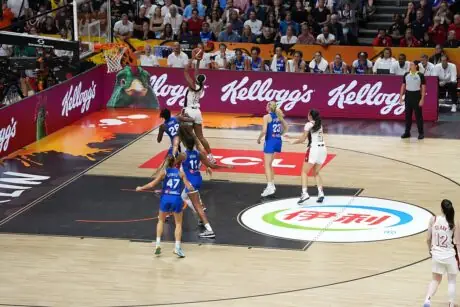
Golden State’s official game recap explains the earlier swing. Williams was scoreless after missing all four of her first-quarter field-goal attempts, then scored 16 in the second quarter while shooting six for nine. Her contribution included a drive, a corner three-pointer and a steal finished at the other end during a pivotal run.
The same account credits Kaitlyn Chen with ending the team’s initial three-point drought after Golden State missed its first eight attempts from distance. Kiah Stokes finished with four blocks, matching her playoff career high.
Those details illustrate why evaluating a performance through one opening stretch is unreliable. The relevant adjustment is not simply whether a player becomes more aggressive. It is whether the team can move that player into situations where the defender must make a different choice. Williams’ varied scoring actions mattered because they required more than one answer. Golden State will want that variety again, without assuming another exceptional quarter will arrive on demand.
Sunday’s update puts the glass and the bench in focus
The freshest team assessment is Golden State’s Game 2 preview, published in its Sunday news feed. It reports a 41–35 overall rebounding advantage and a 12–7 edge on the offensive glass. Kaila Charles collected 10 rebounds. Golden State used 10 players, while Atlanta used seven; the Valkyries’ bench outscored the Dream’s reserves 20–6.
Those numbers give the coaching staffs specific material to examine. An offensive rebound can extend an otherwise unsuccessful possession. A productive reserve unit can preserve the score while allowing starters to rest. Neither benefit appears fully in an individual scoring total.
The preview also notes that Howard and Jordin Canada played 38 of the game’s 40 minutes. That is a significant workload, but workload alone does not prove that fatigue caused a missed shot. Matchups, defensive pressure and ordinary shooting variation are competing explanations. Rotation depth is an area to watch in Game 2, not a settled explanation for every late possession in Game 1.
The defensive identity was established before the Finals
Golden State’s October 15 awards announcement provides relevant regular-season context. Williams made the All-Defensive First Team, with Veronica Burton and Stokes selected to the Second Team. The club says it led the league in opponent scoring at 75.1 points per game and defensive rating at 99.1.
The announcement also lists league-leading opponent field-goal percentage, opponent three-point percentage, opponent points in the paint and opponent assists. Those measures describe different parts of a defensive system: finishing possessions near the basket, contesting perimeter attempts and disrupting the passing that creates easier shots.
They help explain why an inefficient offensive game did not automatically doom Golden State. Still, season averages are context, not a forecast of the next 40 minutes. Atlanta has now seen the Finals version of that defence and has an opportunity to make targeted changes. A strong identity becomes valuable in a series when it survives an opponent’s adjustments.
Both finalists earned their place through convincing semifinals
The official playoff bracket shows why neither team should be treated as a surprise visitor to the championship round. Atlanta swept Washington 2–0 in the opening round and New York 3–0 in the semifinals. Golden State beat Dallas 2–1, then swept Las Vegas 3–0. Golden State is the second seed and Atlanta the fourth.
Atlanta’s report on its semifinal-clinching victory records an 85–83 road win over New York, with Reese scoring 22 points, Howard 21 and Canada contributing 19 points and 11 assists. That earlier performance offers a useful counterweight to the Finals opener’s late drought: the Dream had recently completed a close elimination game successfully.
A single loss changes the series position. It does not erase the evidence accumulated in previous rounds. The challenge for Atlanta is to recover the execution that carried it through those games while responding to a different opponent. For Golden State, the challenge is to prevent a narrow home win from becoming an assumption that the hardest work has already been done.
What comes next, and when to watch from Belgrade
One useful way to follow the next game is to watch the possession after an initial action fails. Does the ball move to a second option, or does the offence stop? Another is to watch who secures the rebound after a well-defended miss. These observations connect the tactical contest to the scoreboard without assuming that every change in shooting percentage reflects a new strategy. They also make the contributions of players without double-digit scoring totals easier to recognise: a recovered possession or a timely defensive rotation can preserve an opportunity that another player eventually converts.
The league’s postseason explanation establishes a best-of-seven Finals using a 2–2–1–1–1 home-court pattern. Four victories are required to win the title. The structure gives both teams room to respond, while making each protected home game valuable.
The current Golden State preview lists Game 2 at Chase Center for Monday, October 19, at 5 p.m. Pacific time, on USA and Peacock. That is Tuesday, October 20, at 02:00 in Europe/Belgrade. It is a scheduled game, not a result. Viewers should use the current team listing for the immediate fixture rather than assume every early-season schedule remains unchanged.
For readers following other competitions, our Broncos–Seahawks report covers a separate close finish. Here, the questions are specific: can Atlanta improve its closing possessions, can Golden State generate more balanced scoring, and will rebounding and reserve contributions remain decisive? Monday’s game will test those possibilities. Sunday’s evidence supports the questions, not a prediction of the champion.
Smashology Editorial Team
The Smashology Editorial Team is responsible for reviewing and publishing content at Smashology Media, overseeing sourcing, fact-checking, corrections, and editorial standards across coverage of internet culture, technology, entertainment, news, and crime.
Sources
Links cited in this article.
- WNBA’s official accountwnba.com
- Associated Press game report carried by the WNBAwnba.com
- Dream’s official reportdream.wnba.com
- official game recapvalkyries.wnba.com
- Game 2 preview, published in its Sunday news feedvalkyries.wnba.com
- October 15 awards announcementvalkyries.wnba.com
- official playoff bracketwnba.com
- report on its semifinal-clinching victorydream.wnba.com
- league’s postseason explanationwnba.com