Japan’s MMX spacecraft has launched successfully on a mission to investigate Mars’s moons and return material from Phobos in 2031. The flight opens a demanding sequence of orbital surveys, rover operations and sampling designed to test how the small moons formed.
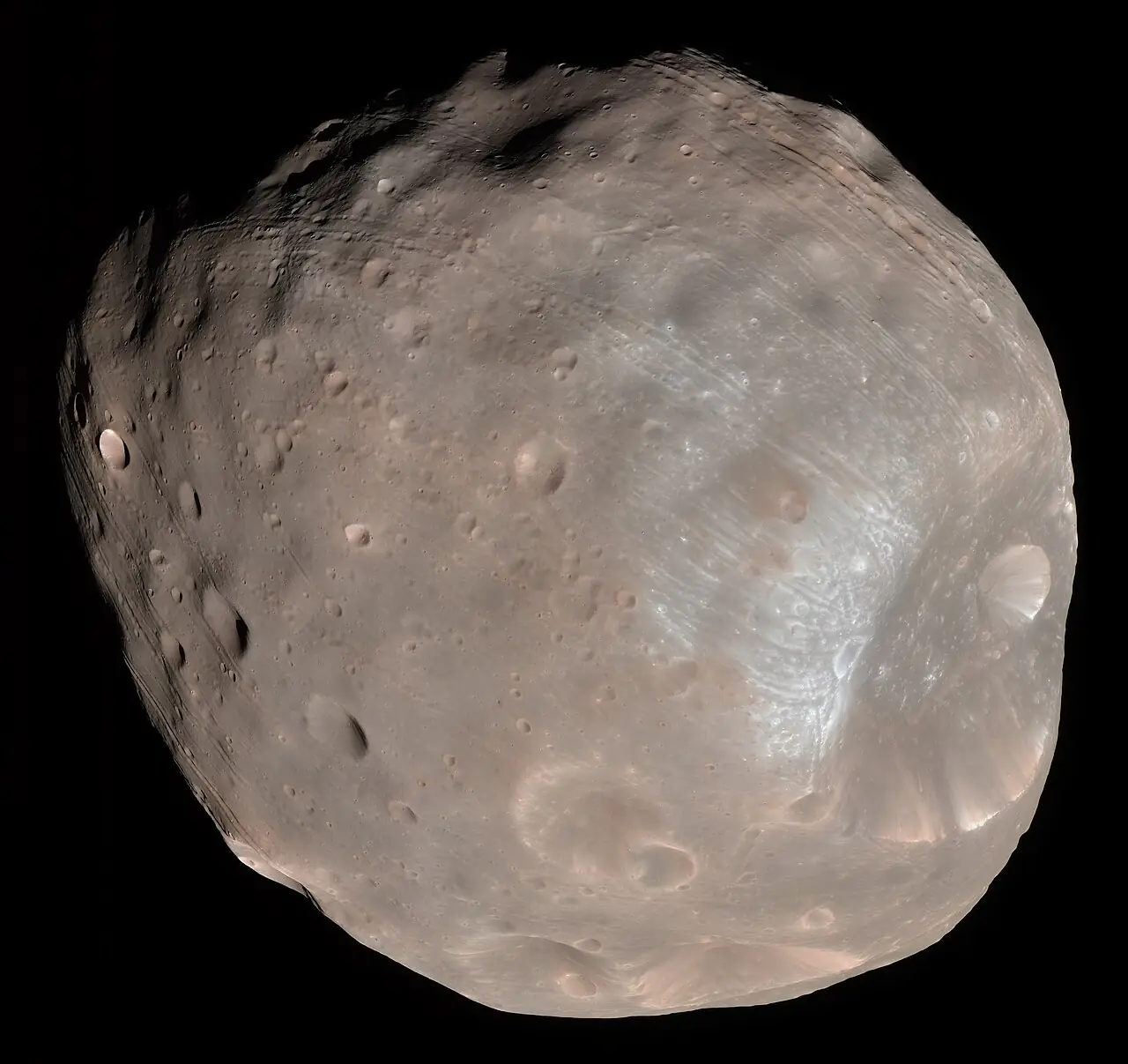
A successful departure, with the main science still ahead
Japan’s Martian Moons eXploration mission has passed its first major flight milestone. JAXA confirmed that H3 Flight 10 lifted off from Tanegashima at 04:41:03 Japan Standard Time on October 20, 2026, and that MMX separated into its intended trajectory one hour, 11 minutes and 13 seconds later. For readers in Serbia and most of continental Europe, that launch occurred at 21:41 on October 19. The different calendar dates describe the same event. JAXA’s launch confirmation establishes the outcome, rather than merely repeating the earlier launch schedule.
The achievement sends a scientific mission toward a destination whose significance is much greater than its size. Phobos is a small, irregular satellite of Mars, but material from its surface could help distinguish competing accounts of the planet’s early history. Launch success establishes that the spacecraft has begun that journey. It cannot yet establish whether the instruments will answer the origin question, whether the landings will succeed or whether a sample will reach laboratories on Earth.
ESA’s October 20 account also confirms the successful departure and identifies arrival at Mars next summer as the next broad destination in the flight plan. That puts the story in its proper phase: MMX is now an outbound mission, with years of operations remaining before the planned return.
Why the origin of two moons remains an open question
Phobos and Deimos could preserve evidence of very different events. In NASA’s account of the mission’s scientific rationale, they may be captured ancient asteroids, or they may have formed from debris thrown into orbit by a major impact on Mars. Establishing which explanation best fits their composition would help researchers reconstruct processes that shaped the inner Solar System. NASA’s October 15 mission briefing presents these as alternatives to investigate, rather than conclusions already reached.
That distinction matters when a mission is described as historic. A compelling objective does not settle the science in advance. A returned grain could be valuable because of its chemical composition, its relationship to nearby material and the geological setting from which it was collected. The interpretation would depend on several measurements agreeing, and on researchers testing whether other processes could have produced similar evidence.
The sample is therefore part of a wider investigation. A close view of a surface tells scientists where a collected fragment belongs; chemical measurements help explain what it contains. Without that surrounding information, even a carefully returned specimen would answer a narrower question. MMX is designed to connect the small scale of individual grains with observations across the moons.
A spacecraft built around several different jobs
The French space agency describes MMX as a system of three modules serving propulsion, exploration and Earth return. Its mission outline includes close study of Phobos, flybys of Deimos and a capsule bringing samples to the Australian desert in 2031. The target sample mass is at least 10 grams. These are planned operations, not completed results. CNES’s project overview also describes MIRS, the infrared spectrometer intended to examine mineral composition and help with landing-site selection.
The modular approach reflects the different demands of the journey. Transporting equipment toward Mars, operating close to a small moon and protecting material for return are separate engineering problems. A vehicle suited to one stage must also leave the next stage able to do its work. For readers following future updates, it will be useful to ask which of those functions a reported milestone actually demonstrates.
An instrument commissioning result, for example, would show that a particular measurement system was responding as expected. It would not by itself demonstrate that the spacecraft could safely touch the surface. Similarly, a successful landing would not automatically prove that the intended quantity of material had entered a sample container. Those distinctions will become more consequential as the mission gets closer to Phobos.
Idefix faces an unusually delicate driving test
The German-French rover Idefix is intended to investigate the surface before the mothercraft’s sampling work. DLR describes a release around the turn of 2028–2029, followed by impact, bouncing and autonomous self-righting. Its planned surface campaign lasts about 100 days. The agency says its measurements will include mechanical, thermal and mineralogical properties relevant to the wider mission. DLR’s launch report makes clear how much of this work lies ahead.
Weak gravity changes what engineers must treat as a routine action. The rover cannot simply be assumed to behave like a heavier vehicle pressing firmly onto an Earth road. Contact with the ground, the ability to recover an operating position and the effect of a movement command all become central questions. A slow, controlled sequence may reveal more useful information than an ambitious attempt to cover distance quickly.
The rover’s role also gives the mission a way to combine local experience with remote observations. A location that looks promising from above still has physical properties that matter when hardware approaches it. This is why surface investigations can influence subsequent decisions without replacing the need for spacecraft-level surveys and navigation.
Two ways of collecting material
The Planetary Society’s mission explanation describes two complementary collection systems. C-Sampler takes a core, while P-Sampler uses pressurised gas to move loose material into a collection container. The society helped support development of PlanetVac, from which the latter technology derives. Its account also explains a practical reason to return specimens: Earth laboratories can use equipment too large, heavy or power-hungry to send with a spacecraft. The Planetary Society’s MMX guide provides this sampling background.
Two collection methods offer different opportunities to learn about a surface. They should not be understood as a guarantee that every attempt will work. Instead, they give the science team different ways to acquire material and potentially compare what is accessible through different physical approaches. The usefulness of any eventual comparison will depend on the actual collection conditions and the record kept of them.
Returning material also allows the scientific value of a mission to extend beyond the lifetime of its flight hardware. A specimen can be examined through more than one technique, and a later research question may call for a measurement not envisaged at launch. That prospect makes careful documentation and preservation part of the scientific mission, rather than an administrative task after the exciting flight stages.
DLR identifies the rover’s RAX Raman spectrometer and miniRAD radiometer as tools for investigating mineralogical and thermal properties. It also describes large temperature changes over Phobos’s roughly seven-hour day-night cycle. Those conditions make the surface campaign a test of how instruments and a small mobile platform function together, rather than simply a matter of obtaining another photograph. The planned operational period will have to accommodate both scientific measurements and the needs of the vehicle carrying them.
International instruments will add independent measurements
MEGANE, the mission’s gamma-ray and neutron spectrometer, was developed by the Johns Hopkins Applied Physics Laboratory with Lawrence Livermore National Laboratory. NASA’s earlier hardware-delivery report explains that it measures emissions from Phobos to investigate elemental composition. The March 2024 delivery was a development milestone; it should not be confused with a new measurement made after this week’s launch. NASA’s instrument-delivery record shows how long the preparation has been under way.
ESA’s contribution includes deep-space communications equipment and ground support through Estrack. European researchers also participate in the science programme. These contributions illustrate how a mission led by one national agency can depend on a broader network of instruments, ground facilities and scientific expertise. The partnerships should be judged through the specific functions they provide, rather than through a vague claim that every partner performs the same role.
Combining measurements is especially useful when a single observation can admit several explanations. Elemental information and mineralogical information address related but different questions. Local surface measurements add another perspective. A strong eventual interpretation will explain how those different lines of evidence fit together, including any disagreement that remains.
NASA also plans to receive and curate approximately 15% of the returned material at Johnson Space Center. The agency’s current briefing places collection no earlier than December 2028. Keeping a documented sample collection available for future researchers is a different contribution from operating an instrument during flight: it supports later comparisons, repeat measurements and questions that may emerge after the spacecraft’s journey has ended.
What readers should watch for next
The immediate news is a confirmed launch and spacecraft separation. The next major chapter is the journey toward the Mars system and the planned arrival in 2027. Surface work is scheduled later, and 2031 remains the planned year for the return capsule. Those dates describe the published mission plan; they are not promises that operations cannot change as engineers learn more about the spacecraft and its destination.
The most informative future reports will state what was observed, when it happened and which objective it advances. A photograph may be spectacular while answering a different question from a chemical measurement. A sample estimate may be encouraging while still requiring later confirmation. Following that evidence step by step will provide a more accurate picture of progress than treating every successful event as completion of the whole mission.
For another example of why measurement and interpretation need to be kept separate, see our report on NASA’s revised Thwaites Glacier modelling. MMX now carries that same basic scientific discipline into a different setting: gather evidence capable of separating plausible explanations, then test what the evidence actually supports. Its departure has been achieved; the discoveries remain to be made.
Smashology Editorial Team
The Smashology Editorial Team is responsible for reviewing and publishing content at Smashology Media, overseeing sourcing, fact-checking, corrections, and editorial standards across coverage of internet culture, technology, entertainment, news, and crime.
Sources
Links cited in this article.
- Image sourcecommons.wikimedia.org
- JAXA’s launch confirmationjaxa.jp
- ESA’s October 20 accountesa.int
- NASA’s October 15 mission briefingscience.nasa.gov
- CNES’s project overviewcnes.fr
- DLR’s launch reportdlr.de
- The Planetary Society’s MMX guideplanetary.org
- NASA’s instrument-delivery recordscience.nasa.gov