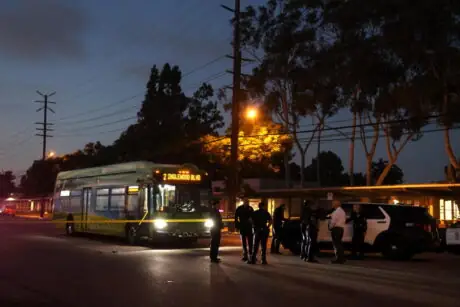
A Tennessee man wanted on a probation violation has been charged with murder of a first responder after Kentucky State Police Trooper Hayden Phillips, 29, was fatally shot during what began as a routine traffic stop on Interstate 65, a killing that has drawn condemnation from Kentucky’s governor and ignited a wave of grief across the small communities where Phillips had spent years working as a firefighter, EMT, and police officer before joining the state police.
Emonnie Dion Branch, 51, of Portland, Tennessee, was arrested the night of the shooting roughly 95 miles away in Jefferson County and was arraigned Tuesday, September 29, 2026, in Warren County, where a judge denied him bond. Branch is now also facing an extradition proceeding tied to an outstanding Tennessee probation-violation warrant issued just weeks before the killing.
A Traffic Stop That Turned Deadly
The shooting occurred Monday night, September 28, 2026, on Interstate 65 in Warren County, Kentucky, during what Kentucky State Police described only as a “routine traffic stop.” Investigators have not publicly detailed the specific reason Phillips initiated the stop, but what followed turned a standard roadside encounter, the kind troopers conduct countless times without incident, into a homicide that was captured on video.
Law enforcement officials said they responded to the scene within minutes of the shooting, but the speed of that response could not change the outcome. Phillips, a three-year veteran of the Kentucky State Police based out of the agency’s Bowling Green post, was pronounced dead, leaving behind a wife and three sons.
A False Name and a Fast-Moving Manhunt
According to court documents and reporting on the arraignment, Branch allegedly gave police a false name during the encounter and in the hours immediately following the shooting, an attempt at concealment that ultimately failed as investigators moved quickly to identify him. He was taken into custody that same night in Jefferson County, nearly 100 miles from the scene of the shooting, suggesting Branch had fled a significant distance in the hours after Phillips was killed before law enforcement caught up to him.
Branch’s criminal history, which prosecutors say includes prior convictions for fraud and impersonation along with allegations of robbery and assault involving a minor, became a central piece of the state’s argument at Tuesday’s arraignment for why he should be held without bond. Prosecutors argued that the combination of his record, his attempt to deceive police about his identity, and the outstanding Tennessee warrant made him both a flight risk and a danger to the community, an argument the Warren County judge accepted in denying bail.
Facing the Death Penalty or Life in Prison
Branch has been charged with murder of a first responder, a charge that in Kentucky carries the possibility of either the death penalty or life imprisonment upon conviction, reflecting the severity with which the state treats the killing of a law enforcement officer in the line of duty. A preliminary hearing addressing the separate extradition matter tied to his Tennessee probation violation was scheduled for Friday, meaning Branch will likely remain in the Kentucky court system for the immediate future even as the Tennessee warrant works its way through a parallel process.
U.S. Attorney Kyle Bumgarner did not hold back in describing the killing, calling it “the most heinous crime that can be committed in our commonwealth” and adding plainly that “one of our own was gunned down.” That language, invoking the idea of a trooper as one of the commonwealth’s own, has echoed through official statements and community reactions alike in the days since the shooting.
A Life of Service Before the State Police
What has made Phillips’s death resonate so deeply in the communities around Russell Springs, Kentucky, is the fact that his three years with the Kentucky State Police were really just the latest chapter in a much longer record of public service. Before joining the state police, Phillips had already served his community as a firefighter, an EMT, and a local police officer, the kind of layered first-responder career that embeds a person deeply into the fabric of a small town long before any statewide recognition comes their way.
That history is precisely why the vigil held in Russell Springs on Monday night drew out firefighters, EMTs, and police officers alongside ordinary residents, people who in many cases had worked directly alongside Phillips in one of his earlier roles before he moved on to the state police. Governor Andy Beshear’s own statement captured that same sentiment, describing Phillips as “a hero who dedicated himself to protecting our commonwealth,” language that speaks to a career spent almost entirely in service roles rather than any single dramatic moment.
Community Response: A Vigil and a Baseball Game
In the immediate aftermath of the shooting, the response from Phillips’s home community took two distinct forms. The first was the candlelight vigil held Monday night in Russell Springs, where the first responders and residents who had known him through his earlier roles gathered to mourn collectively. The second, organized in the days that followed, was a baseball game set up specifically to support Phillips’s three sons, a tangible gesture of ongoing support for a family that lost its father with no warning during what should have been an unremarkable Monday night shift.
That kind of community mobilization, moving quickly from grief to concrete support for the surviving family, has become a familiar pattern in the aftermath of line-of-duty deaths, but it carries particular weight in smaller communities like Russell Springs, where the person being mourned was not a distant public figure but someone who had personally responded to fires, medical emergencies, and calls for service throughout the area for years.
The Broader Pattern of Violence Against Traffic-Stop Officers
Phillips’s death adds to a grim and recurring category of law enforcement fatalities: officers killed during what are classified, at least initially, as routine traffic stops. These encounters are among the most common tasks a patrol officer performs, and the vast majority end without incident, but the unpredictability of who might be in a stopped vehicle, and what they might be willing to do rather than face arrest or a probation violation, makes the traffic stop one of the more statistically dangerous recurring duties in American policing.
In Branch’s case, the combination of an outstanding Tennessee warrant and what prosecutors describe as an extensive criminal history suggests a man who may have calculated he had more to lose from an arrest than most drivers would during an ordinary stop, a dynamic that law enforcement trainers have long identified as one of the hardest risk factors to detect in the seconds before a stop unfolds, since an officer approaching a vehicle typically has no way of knowing a driver’s outstanding warrants or state of mind before the encounter begins.
What Comes Next in the Case
With bond denied and a preliminary extradition hearing set for Friday, Branch’s case is now moving on two parallel tracks: the Kentucky murder prosecution, which carries the most severe potential penalties and will likely take precedence, and the Tennessee probation-violation matter tied to the warrant issued in Sumner County back in August 2026. How those two proceedings interact in the weeks ahead will shape much of the procedural path forward, even as the more severe Kentucky murder charge remains the central legal question hanging over Branch.
For Kentucky State Police, the loss of Trooper Phillips lands as both a personal tragedy for a close-knit agency and another entry in the ongoing national conversation about the risks patrol officers accept every time they initiate what is supposed to be a routine stop. For the community around Russell Springs, the mourning is layered differently: Phillips was not simply a state trooper killed in the line of duty, but a hometown figure whose service to the people around him began long before he ever put on a state police uniform, and whose absence will be felt across every one of the roles he filled over the years.
The Legal Weight of a “First Responder” Murder Charge
Kentucky, like many states, has written enhanced penalties into its criminal code specifically for the killing of law enforcement officers, firefighters, and other first responders acting in their official capacity, a legislative recognition that these deaths carry a distinct public cost beyond the loss to the individual victim’s family. Charging Branch with murder of a first responder rather than a standard murder count opens the door to the death penalty as a sentencing option, a consequence not automatically available in an ordinary homicide case in the state.
Prosecutors will need to establish not just that Branch pulled the trigger, but that he knew or should have known Phillips was acting in his official capacity as a Kentucky State Police trooper at the time of the shooting, a standard that is typically straightforward to meet in the case of a uniformed trooper conducting a marked traffic stop, but one the prosecution will still need to walk a jury through as part of building its case. The video capturing the incident, referenced in reporting on the arraignment, is likely to play a central evidentiary role in establishing exactly that sequence of events.
Sources
- ClickOnDetroit: Man charged in the fatal shooting of Kentucky state trooper was wanted on a parole violation
- WBKO: Bond denied for TN man accused of murdering Kentucky Trooper Hayden Phillips
Leon Ramoviq
Primary Author · Editorial Reviewer · Researcher Leon Ramoviq is a digital media researcher, content creator, and primary author at Smashology Media. His work focuses on researching, verifying, and developing stories across entertainment, culture, sports, internet trends, curiosity-driven topics, and viral news. Before publishing, Leon reviews sources, cross-checks key claims, and works to ensure that articles are clear, accurately represented, and based on reliable information rather than unverified social-media speculation. With experience in digital media, graphic design, social media content, and online audience engagement, he brings both an editorial and visual perspective to the stories published on Smashology. Leon is particularly interested in how stories spread online, why certain topics capture public attention, and how complex or trending information can be presented in a simple and engaging format. Role at Smashology As a primary author and researcher, Leon is involved in: • Researching stories and identifying original or reliable sources • Writing and developing articles for Smashology • Reviewing facts, names, dates, quotations, and contextual information • Checking stories for misleading or unsupported claims • Reviewing articles before publication • Following developments and updating stories when meaningful new information becomes available • Maintaining editorial consistency across Smashology content Editorial Approach Leon believes engaging content should not come at the expense of accuracy. His approach is to combine strong storytelling with responsible sourcing, clear attribution, and additional verification when a story originates from social media or rapidly developing online discussions.