Mexico City’s nineteenth Zombie Walk brought elaborate horror costumes and thousands of participants and spectators into the historic centre on October 18. Behind the striking images, organisers paired a free public gathering with a voluntary food appeal for families in need.
The undead arrived by invitation. Mexico City’s Marcha Zombie returned on Sunday, October 18, filling parts of the capital’s central streets with horror characters, handmade costumes and spectators. La Jornada’s report from the event and Publimetro’s coverage document the gathering, which was advertised by its organisers as the 2026 Zombie Walk.
It is a visually arresting story for an audience accustomed to short clips: familiar streets transformed by people performing unfamiliar roles. The verified event is substantial enough without an invented online milestone. The sources checked for this report do not establish an audited social-media view total or a precise final attendance count. Reports describing thousands should not be upgraded into an unsupported record claim.
A planned gathering, followed by a march to the Zócalo
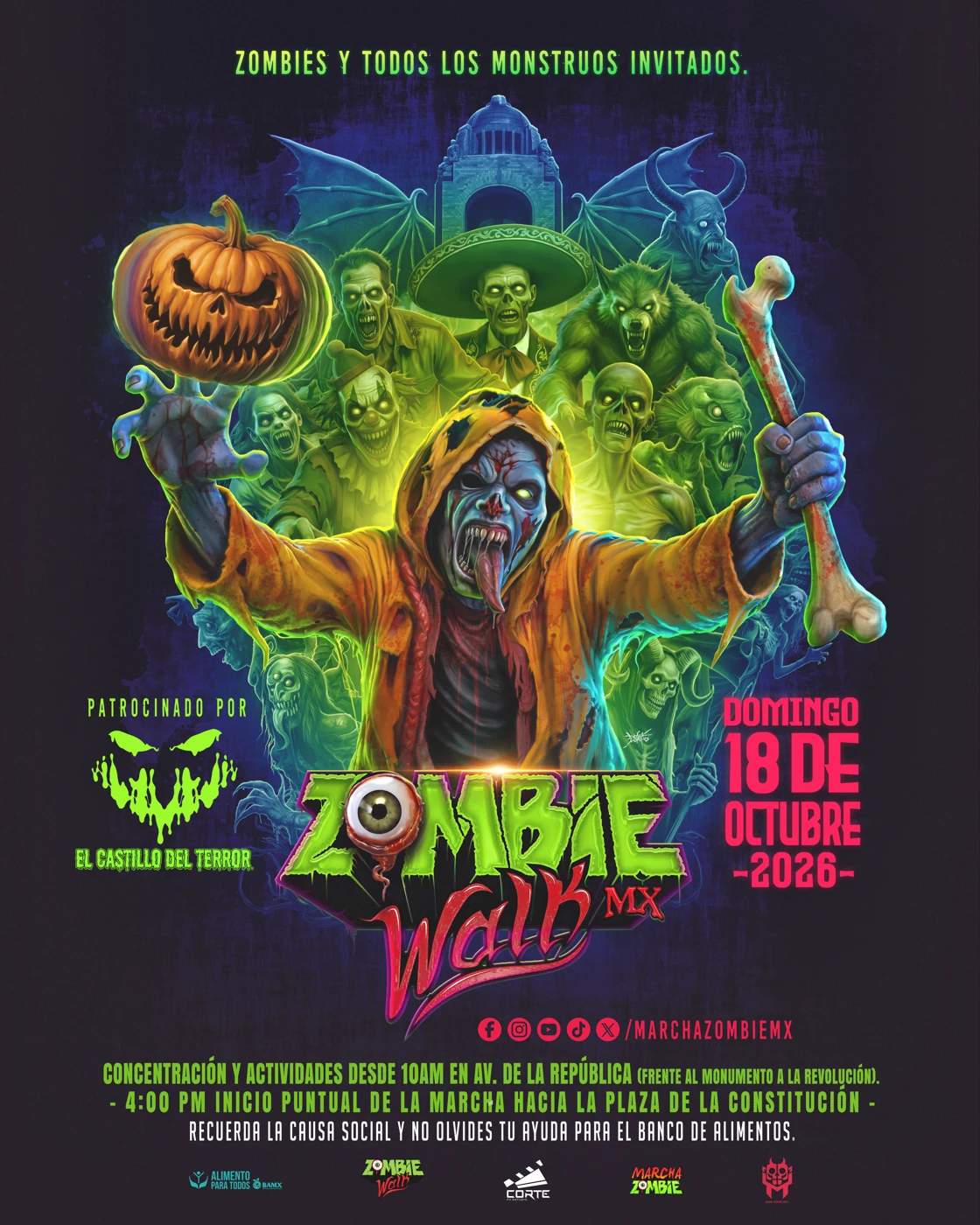
The organisers’ official event page identified Sunday, October 18, with a gathering from 10 a.m. on Avenida de la República, in front of the Monumento a la Revolución. The advertised departure was 4 p.m. The distinction explains why the morning assembly time and afternoon march time both appear in listings: they refer to different parts of the same programme.
The published route crossed Reforma and continued along Avenida Juárez, Eje Central and 5 de Mayo toward the Zócalo. The organisers also announced makeup services and activities before departure. Those details describe the advertised programme; they do not establish that every planned activity took place exactly as scheduled.
Publimetro’s account describes the procession leaving the Monumento a la Revolución and moving toward the Zócalo, with crowds around Avenida Juárez and the Palacio de Bellas Artes. Its photographs and reporting place the costumes within a recognisable urban setting, rather than presenting isolated portraits with no explanation of the occasion.
The costumes drew on much more than zombies
La Jornada described a cast extending to La Llorona, Frankenstein, sinister clowns and other horror creations. Children, young people and adults participated, while families watched along the route. Some costumes used recycled materials or combined different outfits. The effect was a gathering of many small creative projects rather than a single uniform costume.
The newspaper interviewed Rubén Lázaro, who said he had spent a week making his outfit, dedicating up to six hours a day to manual work. That account gives a sense of the preparation behind a fleeting street image. It is one participant’s experience, not evidence that everyone spent the same amount of time or money.
Publimetro highlighted masks, theatrical makeup and clowns carrying chainsaws without chains. The last detail is important to the description of the spectacle. A cropped image of frightening equipment can suggest something different when detached from the performance setting. Reporting what was actually described is more useful than encouraging a false impression of danger.
A food appeal accompanied the horror theme
The official programme linked the march with a voluntary collection of rice, beans and canned goods for Alimento Para Todos I.A.P. It made participation free and located the collection point at the initial gathering area. It explicitly said there would be no collection during the route or at the Zócalo.
A September 23 announcement from Noticias C21, the city’s public broadcaster, similarly presented food donations as voluntary rather than an entry condition. That distinction keeps a social appeal from being misreported as a ticket price. People could join the event without their ability to contribute determining their eligibility.
Mexico City’s public register of private assistance institutions lists Alimento Para Todos and describes its distribution of food and other basic support to people and organisations in need. The register provides independent institutional context for the named charity. It does not tell us how much this particular march collected.
No verified final donation weight or recipient total was found in the event sources reviewed here. An appeal, a collection and the eventual distribution of donations are separate stages. The social purpose is confirmed by the programme; the measurable outcome requires a later accounting from those responsible.
The city broadcaster also announced an alliance with the Zombie Walk associated with Spain’s Galician Freaky Film Festival. That was an intended international connection in the advance programme. The sources reviewed here do not provide a joint attendance figure or establish how many people took part through that relationship, so it should not be converted into an invented multinational turnout.
La Jornada’s street reporting supplied a different kind of context: vendors offered seasonal objects, masks and costumes around the gathering. This places the parade within the ordinary activity of the city as well as its imaginative performance. It does not establish a total economic impact. Individual sales, participant spending and the finances of the organising event would need separate evidence before a monetary success could be claimed.
The event’s rules reveal the work behind the spectacle
The city broadcaster’s advance notice allowed participants to appear as any horror character and advertised a runway-style presentation, themed activities and makeup tents. It also stated that realistic-looking weapons and replicas were prohibited. These were announced conditions for participation, rather than a claim that every object in every photograph has been individually examined.
A pre-event CDMX365 guide published on October 7 described etiquette around asking permission for photographs, avoiding contact with other participants and keeping the procession moving. It should be read as advance practical guidance, not a post-event assessment of how every marcher behaved.
These less spectacular details help explain the event’s structure. A frightening costume works as entertainment because the surrounding arrangement gives it a shared context. A public route, a scheduled start and clear participation rules turn individual performances into a collective occasion that other people can recognise and choose to watch.
Halloween imagery and Day of the Dead have different contexts
The organisers’ branding explicitly invoked Halloween and welcomed a wide range of monsters. That should not be flattened into a description of the march as an Indigenous Day of the Dead ceremony. Mexico’s autumn calendar contains different events whose visual elements can overlap while their origins, meanings and participants differ.
UNESCO’s explanation of the Indigenous festivity dedicated to the dead describes the temporary return of deceased relatives and loved ones, with offerings, candles, flowers and favourite foods helping families welcome them. It places the festivities around the end of October and beginning of November and connects them to the agricultural cycle and community life.
That is a different purpose from a public horror-costume gathering held on October 18. Making the distinction does not require ranking one kind of event above another. It respects the meaning of remembrance while allowing a contemporary recreational march to be understood on its own terms.
Mexico’s traditions are diverse, even where masks overlap
A separate UNESCO feature about Huehues and Xantolo in the Huasteca region illustrates how varied commemorative practices can be. It describes distinct local characters, masks, music and rituals, including differences between communities. Costumes alone do not tell an observer what a procession means.
The feature explains roles for masked figures within those local observances, including guiding souls and visiting homes. These are specific cultural functions, not a generic explanation for any person wearing a frightening mask in Mexico. They should not be transferred to the capital’s Zombie Walk merely because both can produce dramatic photographs.
For an international reader, recognising this variety is the most useful context. A country’s cultural life is not one interchangeable festival. The same season can include family remembrance, religious practice, neighbourhood traditions, commercial attractions and playful gatherings. Accurate captions identify which occasion the viewer is seeing before drawing broader conclusions from it.
What makes the images travel, and what remains unmeasured
The event offers a clear visual contrast: recognisable monuments and ordinary city streets alongside elaborate fictional characters. As an editorial observation, that contrast helps explain why a photograph or short clip can be immediately legible to someone who knows nothing about the programme. The scene communicates a transformation before a caption supplies the details.
Yet visual appeal is not a measurement of distribution. A widely republished photograph may be seen in many places without any single reliable cumulative count. The number of people visible in one frame also cannot establish total attendance, because people enter and leave the route and spectators occupy different locations.
The strongest available description is therefore the one the reporting supports: a nineteenth edition, thousands of participants and spectators, a documented route and an advertised charitable component. None of those details depends on calling the march the biggest ever, claiming a global trend ranking or assigning a fabricated number of online views.
Keep the original date attached when sharing
Some coverage appeared or circulated on October 19, but the march itself happened on Sunday, October 18. That difference is normal in international coverage. It becomes misleading only when a publication date is treated as the event date or when older imagery is presented as a live scene.
A useful caption should name Mexico City, identify the Zombie Walk and preserve that October 18 date. If the image comes from a photographer or news organisation, it also needs proper attribution and permission for reuse. This article links the reporting without reproducing photographs whose publication rights have not been established.
Smashology’s recent coverage of another widely shared video shows why the original context matters even when a clip is authentic. Here, the verified context is festive: people making and wearing imaginative costumes, spectators joining the occasion and an organiser inviting voluntary food donations. The horror was a performance; the gathering and its community appeal were real.
Smashology Editorial Team
The Smashology Editorial Team is responsible for reviewing and publishing content at Smashology Media, overseeing sourcing, fact-checking, corrections, and editorial standards across coverage of internet culture, technology, entertainment, news, and crime.
Sources
Links cited in this article.
- Marcha Zombie Méxicomarchazombie.mx
- La Jornada’s report from the eventjornada.com.mx
- Publimetro’s coveragepublimetro.com.mx
- September 23 announcement from Noticias C21, the city’s public broadcasternoticiasc21.cdmx.gob.mx
- public register of private assistance institutionstoolsportal.jap.cdmx.gob.mx
- CDMX365 guide published on October 7cdmx365.com
- UNESCO’s explanation of the Indigenous festivity dedicated to the deadyoutube.com
- UNESCO feature about Huehues and Xantolo in the Huasteca regionunesco.org