The BFR workout associated with Hailey Bieber has pushed blood-flow restriction training back into the spotlight. Hailey Bieber’s workout routine has put blood-flow restriction training back in the spotlight, but the method is more technical than simply fastening bands around the legs. A workout image discussed by the New York Post showed Bieber using a weighted vest and what appeared to be blood-flow restriction, or BFR, bands. The celebrity hook is new; the training method is not.
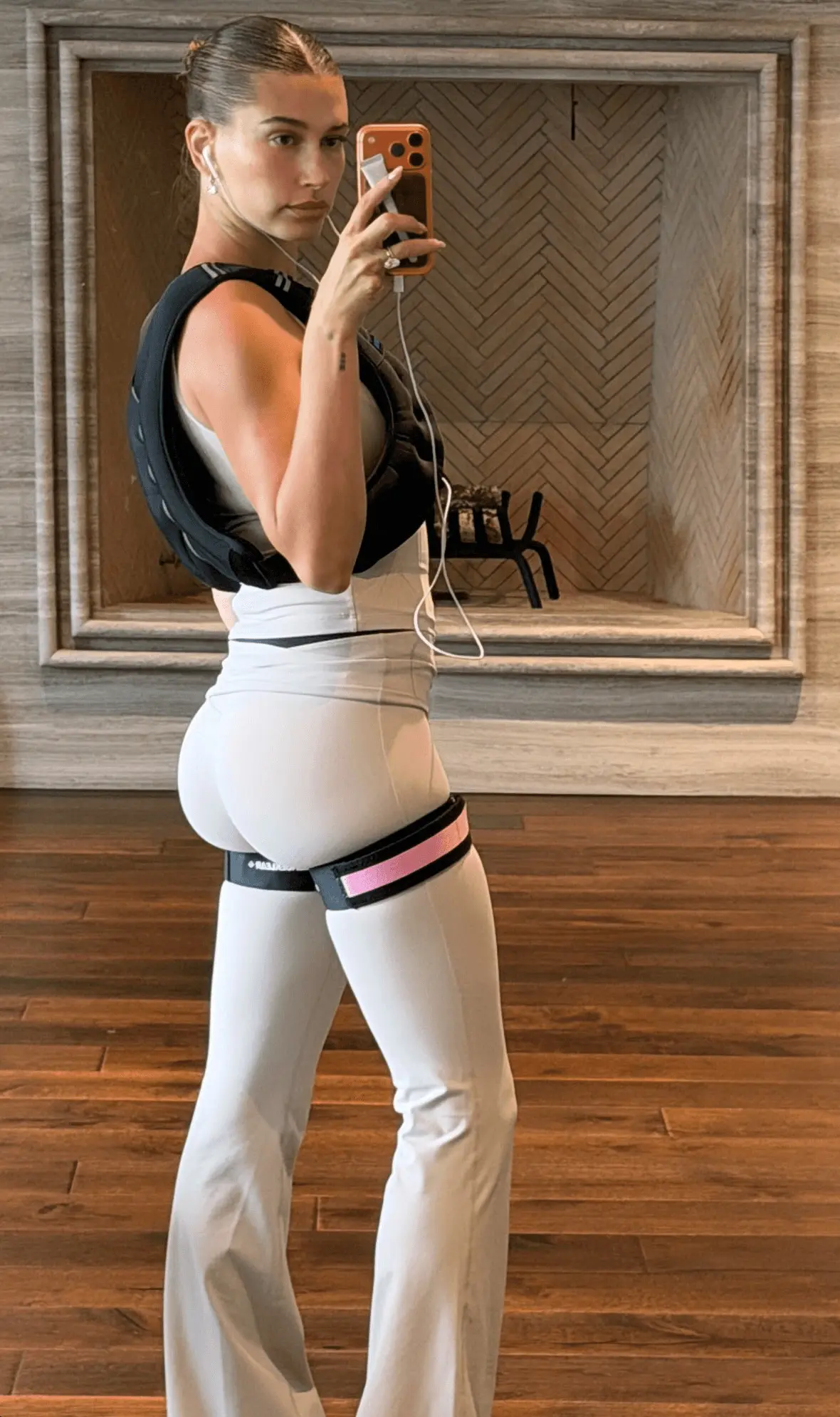
BFR has been studied in sport and rehabilitation because it can help muscles adapt while a person uses relatively light loads. That may be useful when heavy lifting is impractical. It does not make every exercise more effective, guarantee a bigger glute workout or remove the need for progressive training. Pressure, cuff width, placement, health history and supervision all affect both the result and the risk.
What blood-flow restriction training is
BFR uses a specialised cuff near the top of an arm or leg to reduce venous return while allowing some arterial blood to continue entering the limb. The working muscles experience greater metabolic stress than they would during the same low-load exercise without restriction. That stress is one reason relatively light resistance can stimulate strength and muscle growth.
The technique is different from completely cutting off circulation. Professional systems calculate pressure in relation to an individual’s arterial occlusion pressure—the amount needed to stop arterial flow in that limb—and then use only a percentage of it. The Australian Institute of Sport says blood pressure, limb size and cuff width all change the pressure required. Two people using the same number on different cuffs may therefore receive very different levels of restriction.

This is also why improvised straps or bands are not equivalent to a properly measured BFR system. A social-media photo cannot show the pressure being applied, whether screening took place or how long the cuffs were worn.
What the research says about strength and muscle
The clearest potential advantage is that BFR can make low-load resistance exercise more productive. A 2026 systematic review and meta-analysis in the British Journal of Sports Medicine found low-certainty evidence that low-load exercise with BFR improved strength more than low-load exercise alone in people with musculoskeletal conditions.
However, the same review found no clear strength advantage over conventional high-load exercise. That supports a practical interpretation: BFR may be a useful alternative or rehabilitation tool when someone cannot tolerate heavy resistance, rather than a superior replacement for ordinary strength training.
A 2024 meta-analysis of 28 studies involving 542 young athletes reported improvements across several fitness measures, including strength, power and endurance. The results were encouraging, but they do not prove that one celebrity routine will work for every recreational exerciser. The studies used planned programmes, defined pressures and repeated sessions—not an occasional accessory added to an otherwise unchanged workout.
Does BFR “isolate” the glutes?
Claims that BFR bands isolate the glutes from the hamstrings are too strong. Restricting blood flow changes the training stimulus in the limb, but it does not switch neighbouring muscles off. Which muscles do most of the work still depends on the exercise, joint angles, technique, range of motion and fatigue.
A hip thrust, squat, lunge and step-up each distribute load differently. BFR may increase the effort felt during a low-load movement, but it cannot turn poor exercise selection or inconsistent technique into precise muscle isolation. The visible burning sensation is not proof that a programme will produce greater long-term growth.
A weighted vest creates a separate training effect by increasing external load. Combining it with BFR may make a session harder, but “harder” and “better” are not automatically the same. Training benefit depends on whether the total workload, recovery and progression match the person’s goal.

Safety is part of the method—not an optional extra
The Australian Institute of Sport describes BFR as relatively safe for most athletes when applied appropriately, while warning that high-quality safety evidence remains limited because many studies do not report adverse events consistently. Its guidance recommends screening, education, an introductory session, gradual progression and supervision for inexperienced users.
The AIS advises stopping immediately if a participant feels unwell and avoiding BFR while dehydrated. It also recommends individualised pressure rather than copying a setting from another person. The guidance identifies peripheral vascular disease, previous vascular surgery in the affected limb and an arteriovenous fistula as absolute contraindications.
People with a history or suspected risk of high blood pressure, deep-vein thrombosis or pulmonary embolism, stroke, sickle-cell disease, bleeding or clotting disorders, or peripheral neuropathy should obtain medical review before starting. Recent surgery, pregnancy, age and other health factors may also change clotting risk.
A 2020 systematic review of 19 studies in patients with musculoskeletal disorders found that adverse events were uncommon in the available trials, but the total sample was only 322 and many studies had to be excluded because they did not address safety. Reported rare events included deep-vein thrombosis and rhabdomyolysis, while more common effects included acute muscle pain and fatigue. The authors concluded that stronger safety reporting and better screening research were still needed.
What responsible BFR use looks like
- Use equipment designed for BFR. Cuff width and pressure interact, so generic elastic bands offer limited control.
- Start with screening. Health history, recent surgery or injury and clotting risk can change whether the method is appropriate.
- Measure individual pressure. A percentage of measured limb occlusion pressure is more meaningful than copying a fixed number.
- Learn under supervision. New users should have a familiarisation session with a qualified professional.
- Avoid exhaustion. The AIS recommends graded progression and says athletes should not train to exhaustion with BFR.
- Stop for warning signs. Feeling faint, unusual numbness, severe pain or becoming unwell is a reason to stop and seek appropriate advice.
These principles are not a home workout prescription. They explain why a method used in sports medicine should not be reduced to a band placement shown in a social post.
The useful takeaway from the celebrity trend
BFR is not fake fitness science, and it is not a magic shortcut. Evidence suggests it can help people build strength with lighter loads, which may be valuable during rehabilitation, travel or periods when joints and tissues cannot tolerate heavy resistance. For a healthy person who can train conventionally, high-load strength work remains an effective option and may be simpler to programme.
The best question is therefore not whether Bieber’s routine is “the” better butt workout. It is whether BFR solves a specific training problem for a particular person—and whether it can be used with measured pressure, appropriate screening and competent supervision.
What Smashology verified
| Claim | Assessment |
|---|---|
| BFR can improve the effect of low-load resistance exercise. | Supported, although the certainty and size of benefit vary by population and outcome. |
| BFR is clearly better than conventional heavy resistance training for strength. | Not established. Current review evidence finds no clear strength advantage over high-load exercise. |
| BFR bands isolate the glutes and stop the hamstrings working. | Unsupported. Muscle recruitment still depends on the exercise and technique. |
| Any elastic band and copied pressure will produce the same result. | False. Cuff width, limb size and individual occlusion pressure materially affect restriction. |
| BFR is risk-free for everyone. | False. Guidance calls for screening, individualised pressure and medical review for several risk groups. |
This article is general fitness information, not personalised medical or exercise advice.
Sources
- New York Post: Hailey Bieber workout post and BFR trend
- Australian Institute of Sport: blood-flow restriction training guidelines
- British Journal of Sports Medicine: 2026 systematic review and meta-analysis
- Scientific Reports: 2024 systematic review and meta-analysis in athletes
- American Journal of Sports Medicine: systematic review of BFR safety
Leon Ramoviq
Primary Author · Editorial Reviewer · Researcher Leon Ramoviq is a digital media researcher, content creator, and primary author at Smashology Media. His work focuses on researching, verifying, and developing stories across entertainment, culture, sports, internet trends, curiosity-driven topics, and viral news. Before publishing, Leon reviews sources, cross-checks key claims, and works to ensure that articles are clear, accurately represented, and based on reliable information rather than unverified social-media speculation. With experience in digital media, graphic design, social media content, and online audience engagement, he brings both an editorial and visual perspective to the stories published on Smashology. Leon is particularly interested in how stories spread online, why certain topics capture public attention, and how complex or trending information can be presented in a simple and engaging format. Role at Smashology As a primary author and researcher, Leon is involved in: • Researching stories and identifying original or reliable sources • Writing and developing articles for Smashology • Reviewing facts, names, dates, quotations, and contextual information • Checking stories for misleading or unsupported claims • Reviewing articles before publication • Following developments and updating stories when meaningful new information becomes available • Maintaining editorial consistency across Smashology content Editorial Approach Leon believes engaging content should not come at the expense of accuracy. His approach is to combine strong storytelling with responsible sourcing, clear attribution, and additional verification when a story originates from social media or rapidly developing online discussions.